The first time I pushed a full automation workflow live, one that connected our CRM, our analytics stack, our support inbox, and an LLM-based summarizer, and watched it run flawlessly without anyone writing a single line of glue-code… I literally sat back in my chair and thought out loud: “This is how modern companies operate.”
Not because the workflow was flashy. But because of what it represented.
Before AI Automation, my team looked like every team in a high-growth environment:
- Product managers begging for faster experiments
- Marketers stuck copying data across tools
- Analysts drowning in manual exports
- Ops staff juggling fragmented SaaS systems
Everyone had ideas they couldn’t execute without engineering. Everyone was dependent on someone else.
And every quarter, I’d ask the same question in our leadership meetings: “Why can’t we automate more of this?”
The real answer was never talent, it was lack of strategy, time and focus to execute. Too many tools. Too much custom code. Too much dependency. And not enough time to tie everything together in a safe, scalable way.
Then our automation lead walked into my office and said: “Try this new workflow I built.” He shared a workflow link, built entirely in n8n; with API calls, logic branches, an OpenAI integration, conditional triggers, error handlers, everything we normally needed engineering time for.
And yet… It was built by a non-engineer.
In 2025, as companies grapple with data silos, AI pilots, tool sprawl, shifting compliance requirements, and rising pressure for efficiency, n8n has quietly become the home base for teams that want control without complexity, and automation without lock-in.
In this article, I’ll break down:
- What n8n actually is (and what makes it different)
- Why it matters in today’s AI-driven business landscape
- How it works technically
- Who it’s for (and real-world impact examples)
- And how to adopt it using our Align, Automate and Achieve framework so your automation doesn’t suffer the “pilot graveyard” fate
Because if there’s one thing every CEO learns the hard way, it’s this:
The companies that scale aren’t the ones with the most people, they’re the ones with the most leverage. And AI-native automation platforms like n8n are the new leverage.
What Is n8n?

n8n, an open-source, fair-code workflow engine is a customizable automation backbone that lets your entire team orchestrate data, AI, APIs, and operations logic in a way that’s both powerful and approachable.
It gives you the best of both worlds:
- The speed of no-code, the flexibility of code, and the ownership of open-source.
- n8n (pronounced “n-eight-n”) is a “fair-code” workflow automation platform, developed by a company of the same name, headquartered in Berlin.
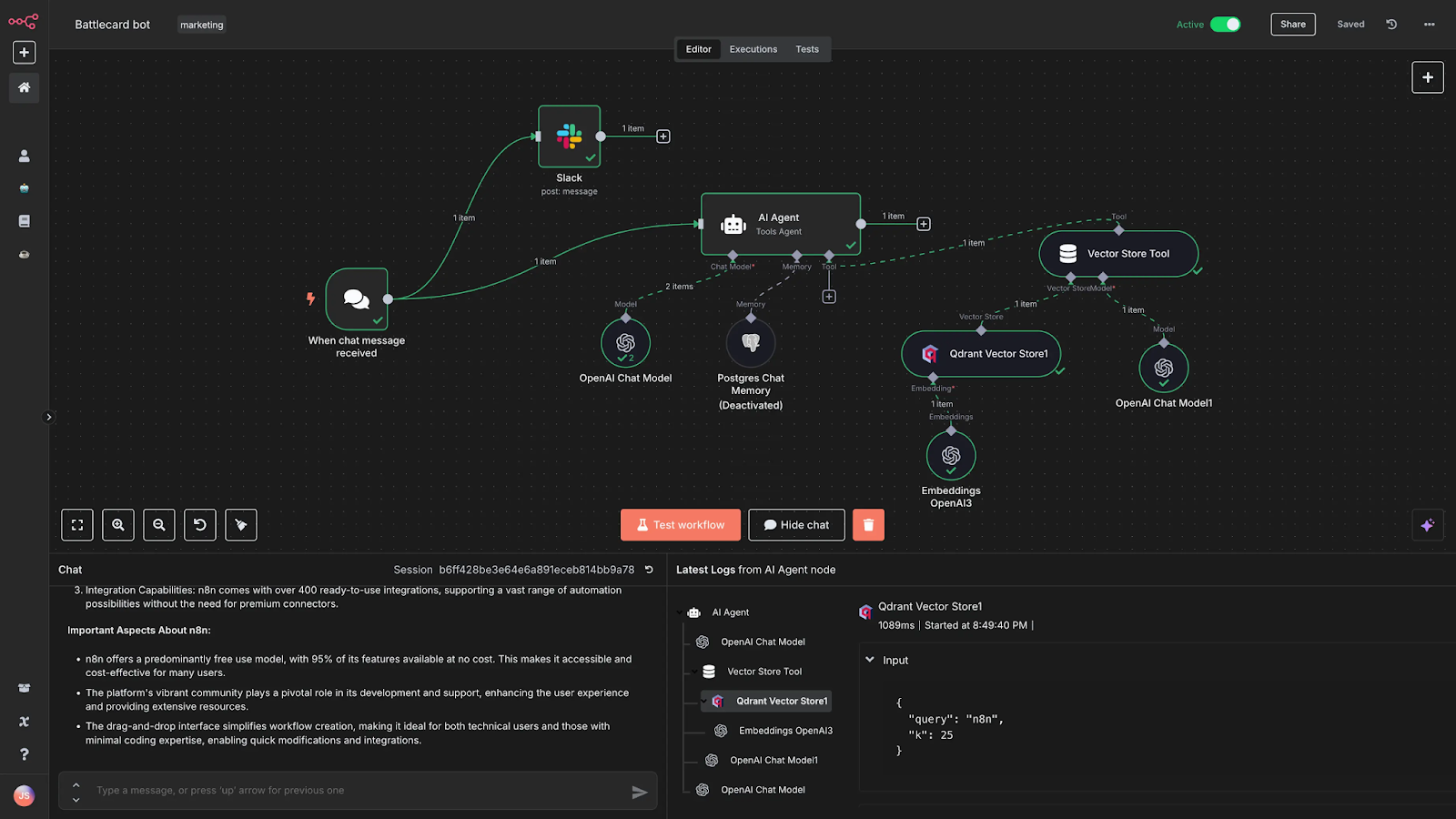
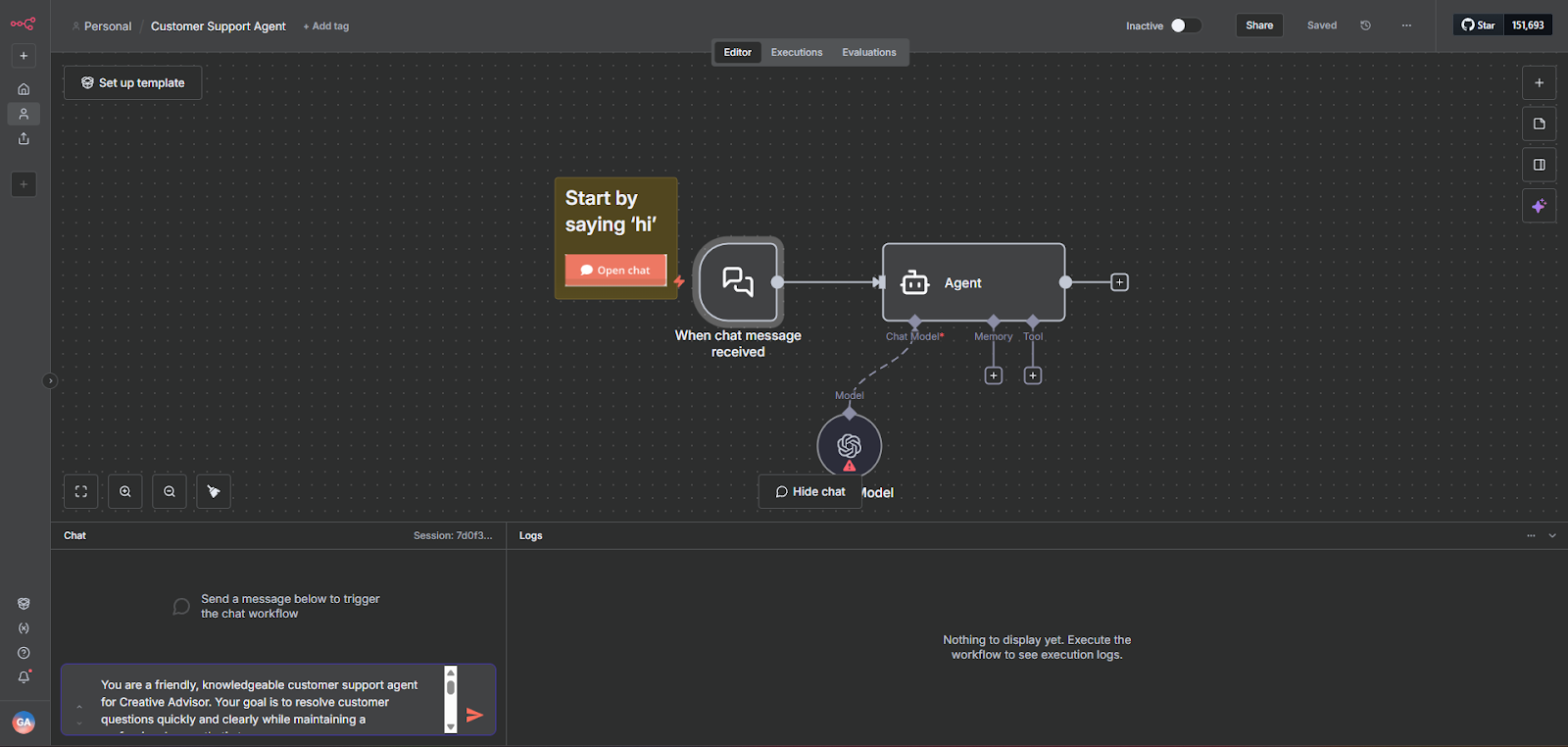
- It provides a node-based visual editor for building workflows: each node represents a step (trigger, API call, data transformation, conditional logic, etc.), and you connect nodes to define the flow.
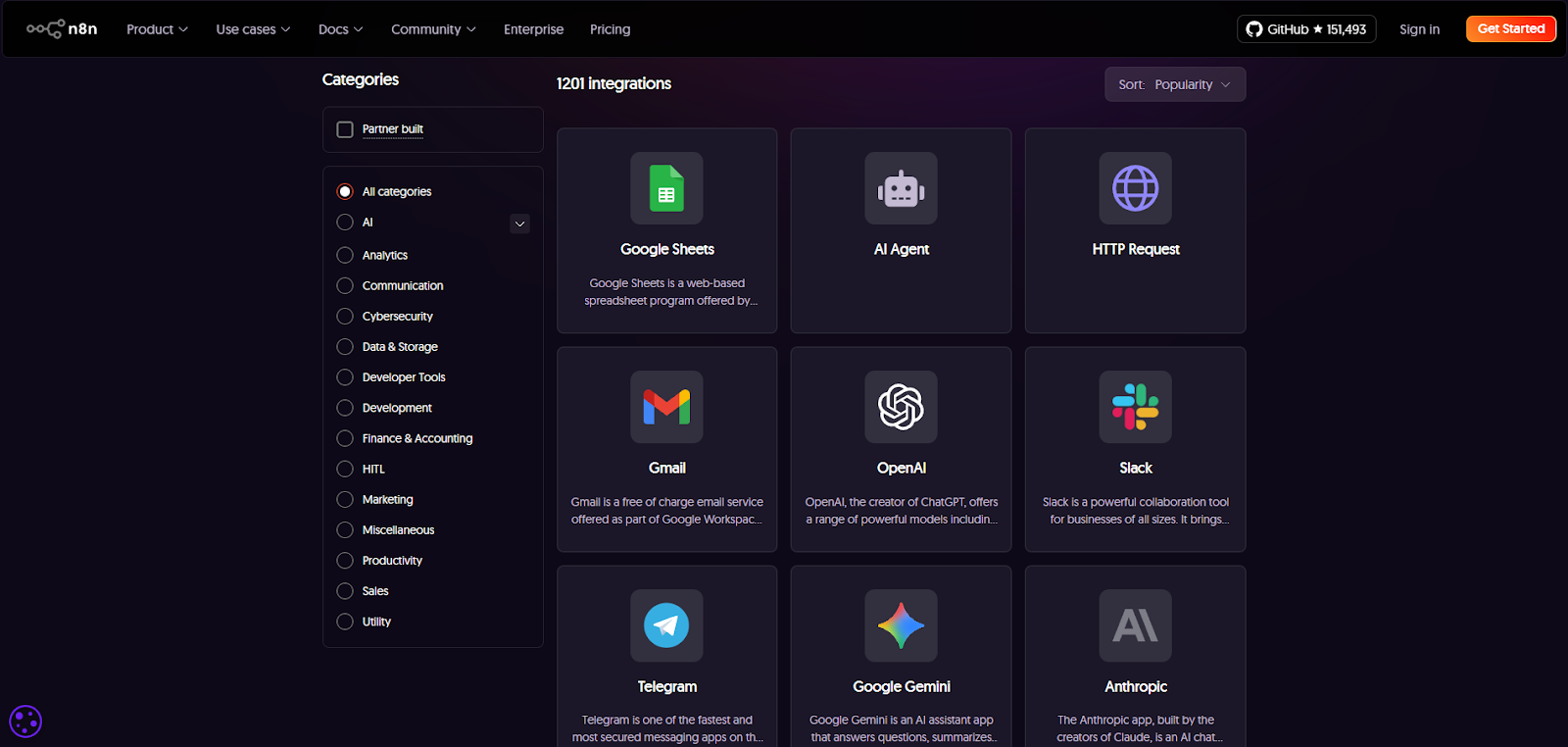
- n8n supports 400+ pre-built integrations (SaaS tools, databases, APIs) and can also connect to arbitrary APIs via an HTTP request node, meaning any system with a REST endpoint can be integrated.
- For more complex logic, workflows aren’t limited to visual nodes: you can embed custom code (JavaScript or Python) inside nodes, giving developers full flexibility when needed.
- n8n supports self-hosting (on-prem, Docker, container environments) as well as a managed cloud option, giving organizations control over data, privacy, and infrastructure.
- More recently, n8n has expanded to include AI-native features: built-in AI/LLM nodes, tools for agent-like workflows (e.g. summarization, classification, automation based on content), making it a strong candidate for “AI + automation + integration” use-cases.
In short: n8n is a hybrid automation engine, part low-code/no-code, part developer-friendly; designed to let teams build, iterate, and run real automation pipelines and even AI-powered agents, without waiting on engineering backlogs.
Why n8n Matters Now
The Case for Automation & Flexibility
Modern organizations juggle more tools, platforms, data sources, and compliance constraints than ever before. Manual workflows, one-off scripts, or proprietary automation tools often lead to:
- Data silos and mismatches
- Long wait times for custom tooling
- Vendor lock-in or privacy concerns
- Difficulty iterating or expanding automations
At the same time, generative AI and LLMs have created new opportunities, but also new complexity in orchestration. Teams need a flexible system that can integrate existing tools + data + AI + business logic.
That’s exactly where n8n fits: a transparent, flexible, extendable workflow engine that evolves as your needs evolve, from simple automation to AI-enriched workflows, all under your control.
Strategic Signals & Market Momentum
- n8n started in 2019 but has grown rapidly. As of 2025, after raising significant funding, it’s positioned strongly as a “fair-code” alternative to proprietary automation. Wikipedia
- The platform now supports 400+ integrations and a growing set of community/partner-built “community nodes,” enabling more tools without compromising stability. n8n
- Its AI-native capabilities (AI nodes, LLM integrations, agent-style workflows) point to a wider trend: organizations are no longer just automating tasks, they want intelligent orchestration (data + logic + AI). n8n
- For businesses concerned with data governance, compliance, or hosting, n8n’s self-host option gives full control over infrastructure, secrets management, and audit logs. Wikipedia
What This Means Strategically
- Agility: Teams can build and deploy automation quickly, without waiting for engineering sprints.
- Scalability: As needs grow (more integrations, AI, conditional logic), you’re not boxed in by simple “if-this-then-that” tools, n8n scales from small automations to complex workflows.
- Control & Compliance: Self-hosting + open-source license = data ownership, privacy, auditability; vital for regulated sectors.
- Future-proofing: With AI integration built in, n8n isn’t just about automating today’s tasks, it’s a foundation for tomorrow’s AI-driven workflows.
In a landscape of fragmented tools and vendor lock-in, n8n stands out as a long-term automation and integration backbone for modern teams.
What n8n Enables Today
Capability | What It Does | Why It Matters |
Visual Workflow Editor (node-based) | Build automations by connecting actions, triggers, transformations in a drag-and-drop interface (n8n) | Lowers barrier, non-developers can build workflows; speeds up prototyping |
400+ Pre-built Integrations + HTTP node | Connect to SaaS apps, databases, APIs; fallback to custom API integrations via HTTP requests (n8n) | Broad connectivity: nearly any external system or service can be part of your workflow |
Custom Code Nodes (JS / Python) | Embed custom logic, data transformations, conditional flows where needed (n8n) | Flexibility for complex or bespoke needs, no limits if visual nodes aren’t enough |
Triggers & Diverse Workflow Start Options | Webhooks, scheduled (cron), event-based triggers, manual or external triggers (n8n) | Automations can be real-time, scheduled, or on-demand; flexible automation timing |
AI / LLM Integration & AI-native nodes | Built-in AI/LLM support: summarization, classification, agents, content generation, document processing, etc. (n8n) | Enables “smart automations”: reasoning, content generation, data analysis, AI agents |
Self-hosting + Cloud hosting options | Run on your servers (Docker, Kubernetes, on-prem) or use managed cloud version (Wikipedia) | Data ownership and compliance control, vital for enterprises or regulated industries |
Debugging, Iteration & Workflow Management Tools | Step-by-step execution, replay data, test nodes, environment separation, versioning, role-based access, secret management, scalability for high throughput (n8n) | Helps ensure reliability, maintainability, and operational safety for real-world automation |
These capabilities combine to make n8n a robust workflow engine, one that scales from simple automation to AI-powered orchestration.
How n8n Works, Technical & Usage Flow
Here’s a simplified breakdown of how you’d build and run a workflow in n8n:
- Trigger or Start: Workflows begin via triggers; webhook, scheduler, event, or manually.
- Node Graph Construction: Using the visual editor, you chain nodes: API calls, data transformations, logic nodes (if/switch), loops, conditionals, custom-code nodes, AI/LLM nodes if needed.
- Execution & Testing: Execute the flow (fully or partial), preview output, debug, test edge cases; n8n supports partial re-runs and quick feedback.
- Optional AI/LLM Processing: If your workflow needs summarization, classification, content generation, or other AI logic; add AI-nodes (LLM nodes, embed-and-query, document parsing, etc.).
- Output / Action: Final outputs go to target systems: databases, HTTP APIs, emails, Slack/MS Teams, CRMs, file storage, notifications; whatever your workflow demands.
- Hosting & Deployment: You can run n8n in the cloud or self-host (Docker/Kubernetes/on-prem) depending on data/privacy needs.
- Monitoring & Maintenance: n8n supports environment separation, role-based access, secret management (Vaults, secure stores), version control, logging; enabling production-grade use.
Because of this flexible yet structured flow, from trigger to output, n8n becomes a versatile backbone for automation: data workflows, AI pipelines, integration orchestration, content workflows, and more.
The Framework: Align → Automate → Achieve for n8n Adoption
Deploying n8n isn’t just about accessing a visual workflow editor or automation tool. It’s about embedding autonomous, scalable workflows, AI‑enhanced automations, and cross-system orchestration into your business processes. Without a structured approach, even the most powerful automation experiments can remain pilots with limited operational impact.
The Align → Automate → Achieve Framework ensures n8n isn’t just a tool, it becomes a system your teams leverage to scale productivity, efficiency, and intelligence across your operations.
Step 1: Align (3 Weeks)
Before deploying n8n in your workflows, you need to define why, where, and how it fits. n8n can only accelerate outcomes that have already been clearly defined.
Key Activities:
Define top business outcomes Examples:
- “Automate lead routing from forms to CRM, reducing manual handoffs by 70%.”
- “Enable real-time analytics dashboards updated from multiple data sources automatically.”
- “Integrate customer support, marketing, and sales systems to reduce repetitive tasks and improve response times.”
Audit current tech stack
- Map all tools and platforms: CRM, project management, databases, SaaS apps, APIs.
- Identify bottlenecks, redundant steps, and data silos.
- Assess integration readiness for AI-enhanced or multi-step workflows.
Interview stakeholders Departments: Marketing, Sales / SDR, Operations, Support, Data/Analytics, Product.
- Surface pain points: repeated data entry, slow lead handoffs, reporting delays, inconsistent workflows.
Design pilot workflows
- Start small: e.g., “Automated lead enrichment + CRM notification + Slack alert workflow.”
- Target high ROI while keeping scope manageable.
Establish governance
- Define approval flows for workflow outputs.
- Implement audit logs to track workflow triggers, node executions, and modifications.
- Set operational guardrails to ensure consistent, compliant, and secure automation.
Departments of Focus & Use Cases:
Marketing & Content Teams
- Pain point: Manual campaign updates across multiple platforms.
- With n8n: Automate campaign asset delivery, content repurposing, and notifications.
- Use case: Generate and distribute 10+ social media posts from a central CMS to all platforms in minutes.
Sales / SDR Teams
- Pain point: Manual prospect follow-ups and performance reports.
- With n8n: Automate email sequences, lead enrichment, and dashboard updates.
- Use case: Weekly automated “new leads → enriched data → personalized outreach” workflow.
Operations / Internal Communications
- Pain point: Manual updates, inconsistent formats across documents or announcements.
- With n8n: Standardize internal communications, automate recurring updates, and ensure consistent formatting.
- Use case: HR sends automated “Welcome new hires” notifications with personalized messages.
Data / Analytics Teams
- Pain point: Manual aggregation of data from multiple sources.
- With n8n: ETL pipelines automatically pull, transform, and push data to dashboards.
- Use case: Consolidate daily sales, website, and ad analytics into a single reporting dashboard.
Executive / Leadership
- Pain point: Lack of visibility into workflow efficiency and automation ROI.
- With n8n + Align: Dashboards track workflows executed, tasks automated, adoption rates, and time saved.
Leadership Alignment Roles:
- CEO / Executive: Defines vision, adoption priorities, and automation outcomes.
- CTO / CIO: Ensures technical infrastructure, integrations, and data readiness.
- CMO / Department Leads: Validate workflows, define process guardrails, and ensure adoption.
- HR / Change Lead: Drives training, cultural adoption, and promotes “human-plus-automation” mindset.
Outcome: By the end of this phase, every stakeholder understands where n8n fits, why it matters, and how they’ll interact with it.
Step 2: Automate (5 Weeks)
With workflows aligned, it’s time to turn n8n into a semi-autonomous operational engine.
Core Execution Layers:
Workflow Intelligence Mapping
- Convert existing manual processes into n8n workflows.
- Define task goals, node sequences, triggers, and conditional logic.
- Map data sources, SaaS integrations, and optional AI/LLM nodes for intelligent automations.
Deployment
- Build and deploy pilot workflows: e.g., lead-to-CRM automation, automated report generation, or internal notification pipelines.
- Collect outputs, review for accuracy, and iterate.
Iteration & Monitoring
- Track workflow reliability, execution times, and output quality.
- Refine nodes, triggers, or AI integrations as needed.
- Implement feedback loops to continuously improve efficiency and alignment with objectives.
Team Training & Calibration
- Teach staff how to create, monitor, and refine workflows.
- Encourage iterative refinement and collaborative usage across departments.
n8n Core Features & Executive Benefits:
Component | What it does | Why it matters |
Node-based Workflow Editor | Drag-and-drop visual workflow builder | Allows non-technical users to create automations quickly |
Trigger & Event Handling | Supports webhook, cron, manual, or event-based triggers | Automations can run real-time, scheduled, or on-demand |
Integrations + HTTP / API Nodes | Connects to 400+ apps and custom APIs | Broad connectivity; almost any system can be automated |
AI / LLM Nodes | Enables summarization, classification, content generation, intelligent agents | Introduces AI-powered decisions into workflows |
Custom Code Nodes | Allows JavaScript / Python scripts for advanced logic | Handles complex or bespoke workflows |
Self-Hosting & Cloud Options | Flexible deployment & data control | Meets privacy, compliance, and scalability requirements |
Debugging & Monitoring | Step-through execution, replay, logs, and version control | Ensures reliability and maintainability |
Outcome: By the end of this phase, n8n can autonomously execute workflows, integrate data, and even leverage AI-enhanced automation while your team shifts from execution to strategic oversight.
Step 3: Achieve (2–3 Weeks)
Now you scale, refine, and institutionalize n8n in daily operations.
Steps:
Deploy performance dashboards
- Track workflow execution, automation completion, time saved, and errors avoided.
- Measure alignment with business objectives and KPIs.
Monitor adoption & usage
- Identify which teams are actively using n8n.
- Detect override cases, bottlenecks, or underutilization.
Continuous improvement loops
- Refine workflows, AI node prompts, integrations, and data mappings based on performance metrics.
- Expand automation to additional departments, business units, or multi-brand operations.
Scale across teams
- Extend n8n deployment across enterprise teams, multiple sites, or agency clients.
- Train additional staff, reward adoption, and showcase best practices.
Embed a “human-plus-agent” mindset
- Treat n8n as a collaborator, and not as a replacement.
- Focus human effort on oversight, strategy, and optimization while n8n executes workflows autonomously.
Outcome
Within approximately 10 weeks, n8n becomes a core operational infrastructure:
- Workflows, automations, and AI-enhanced processes run automatically.
- Teams gain time for high-level strategic thinking.
- Enterprise-wide productivity, efficiency, and cross-system orchestration are dramatically improved.
This framework ensures n8n adoption is transformational; integrating automation, intelligent workflows, and AI-enhanced orchestration directly into business processes.
What n8n Does Well
- Flexibility + power: Supports both no-code visual automation and code-based custom logic; ideal for both non-technical and technical users.
- Broad integrations: 400+ built-in integrations, HTTP fallback, plus custom code; you’re unlikely to run out of connectivity.
- AI-native workflows: Native support for AI/LLM nodes and agent-style orchestration, good for modern automation needs (content generation, data analysis, summarization).
- Self-host & data control: For privacy, compliance, and security-sensitive use-cases, n8n’s self-hosting is a major advantage.
- Open source / fair-code license: Transparency, community-driven node ecosystem, no vendor lock-in, ability to inspect or modify code.
- Scalable & maintainable: With debugging tools, environment management, role-based access, and support for high execution load, suitable for real production workflows.
Ultimately…
If your team, even a small one, deals with multiple tools, data sources, repetitive tasks, or manual handoffs; and if you want to move fast without compromising control or privacy: n8n is a strong candidate to become your automation backbone.
By combining visual flows, deep integrations, custom code, AI-native nodes, and self-hosting flexibility, it offers the best of no-code, low-code, and traditional engineering; a hybrid tier that fits the complexity and dynamism of modern teams.
If you’re an operations lead, product manager, data or marketing head: start small. Pick 1–2 repetitive workflows. Build them in n8n. Test. Deploy. Measure. Use the Align → Automate → Achieve framework to scale.
In doing so, you shift from “ad-hoc scripts and infinite tool juggling” to “reliable, maintainable automation pipelines.”
Would you like to free up human time, reduce errors, and let your team focus on value, instead of mechanics?
🚀 Free Resource: Leading AI-Enhanced Teams
📅 Complimentary AI Strategy Session: Book your 30-minute Align AI Strategy Session.
n8n can become your automation engine; flexible, open, powerful, and future-ready.