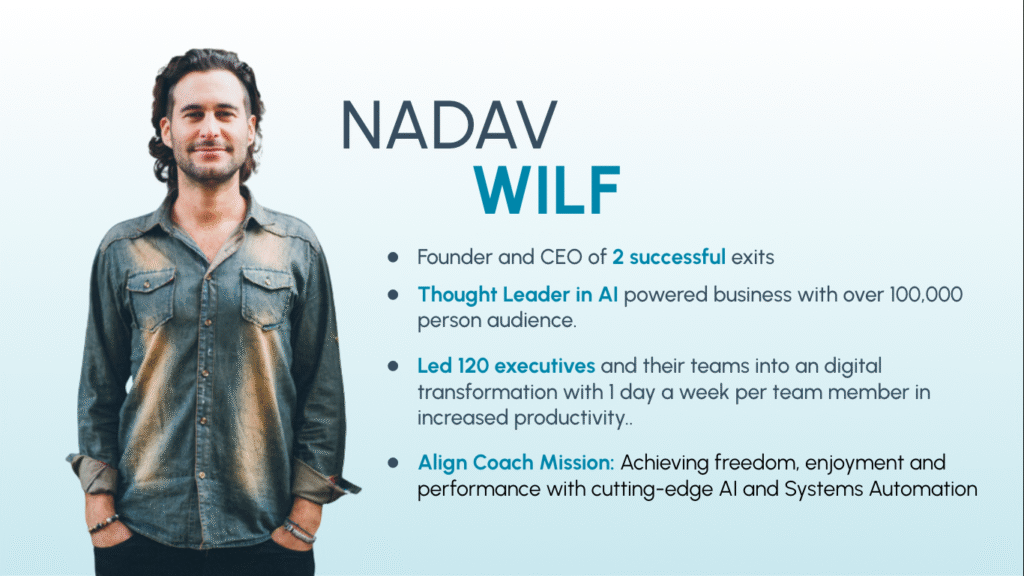
As a CEO, most people imagine my days as a whirlwind of high-stakes decisions, full days meetings, and constant problem-solving. That is a past reality before heavily investing time, resources and focus into working ON the business in the era of AI and automation vs. IN the business.
Without structure, without automation, and without clear operational visibility, even the most capable executive can get trapped in a cycle of reactive work, spending more time managing processes than leading strategy.
Early in my entrepreneurial journey, I noticed a consistent pattern: the more the company grew, the more my time was consumed by operational firefighting, reviewing reports, chasing updates, approving minor decisions, and answering emails. Despite having a talented team, a lot of energy was wasted, and the work I truly wanted to focus on; strategic planning, cultivating company culture, engaging with key stakeholders, and innovating; was constantly delayed or pushed aside.
Can you relate to this?
This realization prompted a critical question: How can I reclaim my time while ensuring every department continues to run and grow efficiently and independently?
The answer came through a structured approach to AI, automation, and operational alignment, implemented across departments, combined with disciplined meeting rhythms, transparent dashboards, and accountability frameworks.
The result: I now have 35 hours a week of focus and strategy time, time I use exclusively for thinking and high-impact work that drives company growth and long-term value.
If you want the same for yourself, I’ve shared in detail how I structured each department, invested strategically in AI through our Grow Package, applied the Align → Automate → Achieve (AAA) framework, and created an organizational system where operational tasks are automated, teams self-manage, and leadership bandwidth is maximized.
The Challenge: Time Lost in Admin and Management
Even in an organization of A players, operational debt can silently consume productivity. Tasks such as approvals, reporting, coordination, data analysis, and administrative work can collectively eat up 10-30 hours per week of each person’s time per department, leaving teams and executives in a perpetual reactive mode.
For me, doing admin and micromanagement is soul crushing, as I’m passionate about vision and creativity. Before reclaiming this time, I would remain perpetually reactive and in the on fire weeds, unable to devote my energy to high-value tasks like:
- Advancing company Objectives and Key Results
- Planning strategic initiatives
- Meeting key clients, partners, and investors
- Coaching leaders and elevating company culture
The solution required not just tools, but a methodology that ensured efficiency, accountability, and alignment across the entire organization.
Investing in AI and Automation is Investing In Yourself
I have a mantra as CEO:
“Everyone can do things better than I can.”
This frees me from being important or necessary for progress, in fact it can be said I hinder progress if I’m too involved.
To operationalize myself, I implemented AlignCoach.ai’s Grow Package, a $5,000/month investment in AI and automation workflows into each of our organizational departments.
Departments:
- Executive
- Sales
- Marketing
- Operations
- Human Resources
- Finance
- Client Success
The package includes these monthly initiatives:
- AI Agents / Automation Workflows: 5 per department
- Automated Dashboards: 2 per department
- AI and Automation Plans: 2 comprehensive plans
- Department Systems Maps: 2 process maps
- Dashboard and Workboard Accuracy Monitoring: 10
- Customer Service Response Time: Same-day
AI & Automation Team
Role | Hourly Rate | Weekly Hours | Purpose |
VP of AI Strategy | $250/hr | 6 | Strategic alignment, oversight, KPI integration |
AI Systems Development | $150/hr | 24 | Workflow development, dashboards, automation scripts |
AI Training & Support | $50/hr | 8 | Train staff, refine AI workflows, provide support |
Total Hours | | 38 hrs/week | Operational capacity added |
This investment adds 10-30 hours of operational capacity per week per team member, equivalent to a full-time executive per department, allowing me to focus exclusively on strategic priorities.
Applying the Align, Automate, Achieve Framework
To ensure the investment translated into tangible outcomes, I applied the Align → Automate → Achieve (AAA) framework across all departments.
Step 1: Align (Weeks 1–3)
Before automating anything, we aligned each department:
- Business Goals & OKRs: Clearly defined outcomes for operations, marketing, sales, HR, finance, and customer success.
- System Mapping: Every process was documented, redundancies identified, and escalation protocols established.
- Team Clarity: Employees understood their responsibilities and how AI and automation would enhance their work.
By the end of Week 3, all departments had:
- Clear AI & automation plans
- Defined KPIs and outcomes
- Process maps for operational clarity
Step 2: Automate (Weeks 4–8)
Automation workflows were implemented to reclaim hours across all departments:
Sales Department
AI and automation targeted the core revenue-driving workflows:
- Lead Qualification and Prioritization: AI analyzed incoming leads, scoring them based on engagement, potential value, and likelihood to convert, ensuring the sales team focused on high-impact prospects.
- Activity Tracking, Outreach & Follow-ups: Automated reminders and email sequences ensured timely follow-ups without manual tracking.
- Prospect Scheduling: AI-assisted calendar management allowed prospects to self-book based on team availability.
- Prospect Data Entry & Updates: All prospect interactions were automatically logged in the CRM, reducing manual data entry by 8–10 hours per week.
- Pipeline Forecasting & KPI Insights: AI dashboards provided real-time forecasting and KPI insights, highlighting gaps and opportunities before they became bottlenecks.

Impact: Reclaimed ~40 hours/week, adding 160 hours/month, with an annual productivity value of $120,000.
Marketing Department
AI workflows transformed content creation and campaign management:
- Content Creation: AI-assisted ideation, drafting, and SEO optimization reduced research and drafting time by 12 hours per week.
- Content Marketing Automation: Email sequences, drip campaigns, and social posting were fully automated, freeing up additional time for strategic planning.
- Channel Campaign Optimization: AI dynamically adjusted ad bidding, audience targeting, and A/B tests.
- Marketing Project Management: Tasks were automatically tracked, deadlines updated, and dependencies flagged, reducing meeting overhead.
- Performance Analytics & Insights: Dashboards automatically collected campaign performance metrics and highlighted actionable insights.
Impact: Reclaimed ~38 hours/week, adding 152 hours/month, with an annual productivity value of $91,200.
Operations Department
AI streamlined planning, reporting, and execution:
- Project and Resource Planning: AI analyzed project timelines and resource availability, ensuring optimal allocation.
- Workflow Optimization & Automation: Repetitive operational workflows were automated to reduce bottlenecks.
- Task & Project Management: AI assigned tasks, updated status, and alerted stakeholders automatically.
- Data Entry & Report Generation: Manual reporting was eliminated; dashboards generated real-time operational data.
- Project Reporting Analytics: AI provided predictive insights, identifying potential delays and cost overruns.
Impact: Reclaimed ~42 hours/week, adding 168 hours/month, with an annual productivity value of $100,800.
HR Department
HR processes were automated to improve efficiency and employee experience:
- Candidate Sourcing and Screening: AI scanned resumes and ranked candidates based on predefined criteria.
- Interview Scheduling & Coordination: Automated calendar management reduced administrative time.
- Employee Onboarding & Training: Onboarding workflows and training assignments were automatically triggered.
- HR Analytics & Workforce Planning: AI dashboards tracked headcount, attrition, and performance metrics.
- Employee Satisfaction Tracking & Surveys: AI conducted pulse surveys and analyzed sentiment for actionable insights.
- Payroll & Benefits Management: Automated calculations and reminders minimized errors and saved time.
Impact: Reclaimed ~39 hours/week, adding 156 hours/month, with an annual productivity value of $96,600.
Finance Department
Finance workflows were optimized for accuracy and efficiency:
- Expense & Budget Management: AI automated budget tracking and flagged anomalies.
- Vendor Management & Accounts Payable: Invoice approvals and payments were streamlined via automated workflows.
- Invoice Processing & Accounts Receivable: AI assisted with invoicing, reminders, and reconciliation.
- Financial Forecasting & Risk Analysis: Predictive dashboards provided forward-looking insights for strategic decisions.
- Tax Compliance & Audits: AI ensured regulatory compliance and automatically flagged potential audit risks.
Impact: Reclaimed ~32 hours/week, adding 128 hours/month, with an annual productivity value of $76,800.
Client Success Department
AI enhanced customer engagement, satisfaction, and retention:
- Customer Support: AI-assisted ticket triage and response suggestions reduced response times and improved resolution rates.
- Customer Surveys & Sentiment Analysis: AI analyzed feedback for trends and actionable insights.
- Customer Outreach & Engagement: Automated follow-ups and check-ins maintained relationship continuity.
- Renewal & Upsell Tracking: AI identified opportunities for renewals or upsells and flagged them for action.
- Ticket Resolution: Escalation workflows ensured high-priority tickets were resolved promptly.
- Onboarding & Systems Training: New clients automatically received onboarding guidance and training content.
- SLA Compliance & Customer Performance Reporting: AI monitored SLAs and generated performance reports for transparency.
Impact: Reclaimed ~42 hours/week, adding 168 hours/month, with an annual productivity value of $79,200.
By Week 8, departments achieved measurable efficiency:
Department | Hours Saved / Week | Monthly Productivity Hours Added | Annual Productivity Value Added |
Sales | 40 | 160 | $120,000 |
Marketing | 38 | 152 | $91,200 |
Operations | 42 | 168 | $100,800 |
HR | 39 | 156 | $96,600 |
Finance | 32 | 128 | $76,800 |
Customer Success | 42 | 168 | $79,200 |
Total | 233 | 932 | $564,600 |
Automation transformed operations from reactive to proactive, and freed leadership from low-value tasks.
Step 3: Achieve (Weeks 9–10)
The Achieve phase focused on sustained operational excellence:
- Dashboards: AI-driven tracking of KPIs, OKRs, and operational efficiency.
- Predictive Alerts: AI flags anomalies or bottlenecks before they impact outcomes.
- Self-Management: Teams use dashboards to track their progress, escalate only critical issues.
By Week 10, departments were fully aligned, workflows automated, and time reclaimed for strategic initiatives.
Meeting Rhythms and Transparent Workflows
A critical component of reclaiming my CEO time is structured meeting rhythms:
- Weekly Department Strategy Sessions: I attend only when escalations require my input. Everything else is reviewed and resolved beforehand.
- Daily Automated Updates: Dashboards summarize progress, issues, and key metrics, eliminating unnecessary check-ins.
- Weekly Executive Reviews: Focused purely on strategy, OKRs, and high-impact decisions.
Because teams self-manage using transparent workboards and dashboards, my time is freed to focus on high-leverage activities:
- Strategic thinking and planning initiatives
- Meeting key stakeholders and partners
- Cultivating company culture and reinforcing values
- Coaching leadership and high-performing employees
How Other CEOs and Executives Are Embracing AI
Understanding the broader market context helps underscore why reclaiming time through AI and automation isn’t just a tactical choice, it’s strategic. Here are key insights into how top executives, including CEOs, are adopting and leveraging AI:
- According to KPMG’s 2025 Global CEO Outlook, 71% of CEOs say they are investing in AI (and an equal percentage in talent) as a key to future growth.
- In the report by IDC titled The 2025 CEO Agenda, Transforming Business for an AI World, over half of CEOs believe AI will allow them to reinvent their business model within 3-5 years, with operational efficiency topping the list of business benefits.
- According to McKinsey & Company’s “AI in the Workplace” report, 92% of executives say they expect to boost AI investment in the next three years, and 55% expect their investment to increase by at least 10%.
- A recent survey found that 78% of global companies are using AI in their everyday business operations in 2025, while over 90% are either using or exploring AI.
These numbers tell a clear story: AI has moved from experiment to executive essential. What once felt like a futuristic advantage is now a baseline expectation of modern leadership. CEOs are using AI to reclaim time, sharpen decision-making, and amplify strategic impact.
The leaders gaining back 30+ hours a week means working smarter, orchestrating intelligent systems that handle the operational noise so they can focus on vision, growth, and culture.
The Impact: 35 Hours a Week for Strategic Work
Thanks to AI, automation, and disciplined workflows:
- I now have 35 hours/week to focus on strategic, high-value work. I get to focus on what I planned to focus on, moving the needle on the most important KPIs.
- Departments and their team members operate collaboratively and independently, with clear responsibilities, dashboards, and escalation protocols. This fosters leadership and innovation.
- Operational excellence is measurable, hours reclaimed, productivity value added, and OKRs advanced.
The combination of AI investment, structured frameworks, and transparent workflows has created a multiplier effect: productivity gains across departments and strategic bandwidth at the executive level.
Lessons Learned
- Strategic AI Investment Pays Off: A $5,000/month in-house AI and automation investment yielded the equivalent of multiple full-time employees across departments.
- AAA Framework is Scalable: Align → Automate → Achieve works internally just as effectively as in client engagements.
- Transparency Enables Self-Management: Teams that can see, track, and escalate work autonomously free leadership bandwidth.
- Reclaimed Time Drives Impact: Strategic initiatives, culture, partnerships, and growth happen when executives have dedicated focus time.
Therefore…
Time and thoughtfulness is the ultimate leverage for a CEO!
By structuring departments effectively, investing strategically in AI and automation, and applying the AAA framework, I’ve created 35 hours of focus time per week.
This bandwidth allows me to focus on high-impact initiatives, while departments operate independently, efficiently, and in alignment with company goals.
The result is a company that runs smoothly, efficiently, and strategically, where both leadership and employees are empowered, and growth is accelerated.
Want to learn how to reclaim executive bandwidth using AI and automation?
📘 Free Guide: Leading AI-Enhanced Teams
📅 Complimentary 30-min AI Strategy Session: Discover how structured AI, automation, and the AAA framework can free your time and elevate your organization.
Align. Automate. Achieve.