
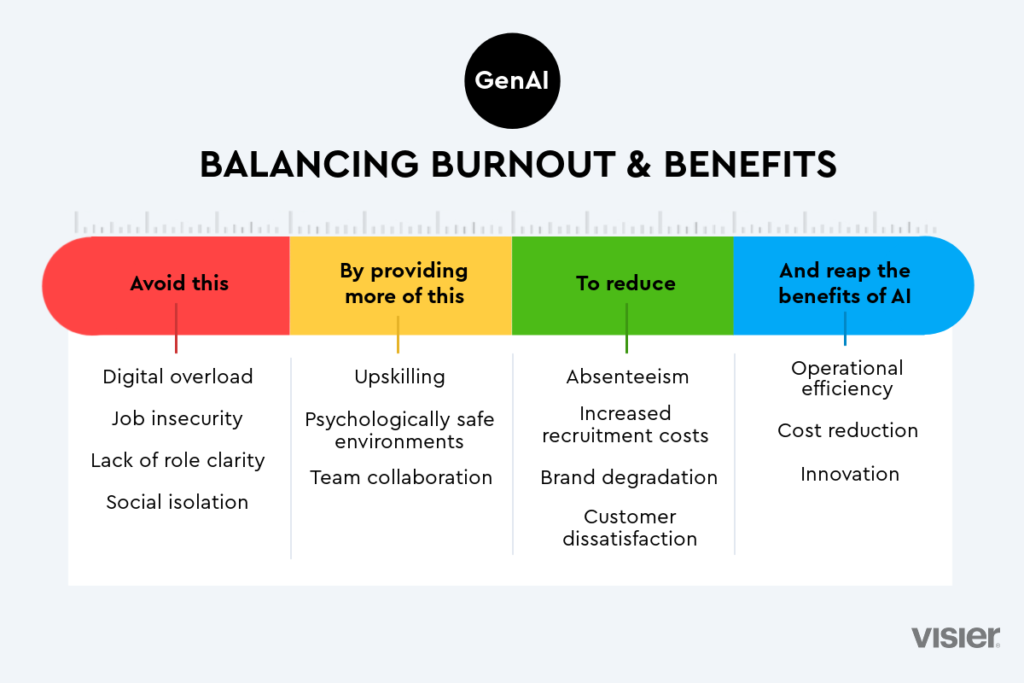
Employee burnout has become an operational failure across companies.
Modern work environments rely heavily on information flow, coordination across tools, and rapid decision-making. When these elements are not supported by well-designed systems, employees absorb the resulting inefficiencies through longer hours, constant context switching, and manual effort spent on low-value tasks. Over time, this accumulation of friction contributes directly to emotional exhaustion and reduced job satisfaction.
Artificial Intelligence has emerged as a practical capability for reshaping how work is structured and executed. When integrated into core workflows, AI can reduce manual effort, stabilize processes, and improve clarity around priorities and responsibilities. Its impact extends beyond productivity metrics. By changing how work moves through the organization, AI influences how employees experience their roles on a daily basis.
Research shows a consistent relationship between well-implemented automation and improved employee outcomes. Salesforce reports that AI-driven service automation now resolves up to 85–93% of customer inquiries, significantly improving response speed, accuracy, and overall customer experience, key drivers of higher customer satisfaction.
These gains are most pronounced when automation is embedded into everyday systems rather than added as standalone tools.
This article explains how AI reduces burnout and increases employee satisfaction, what the data actually shows, and why workflow-level automation, not isolated AI tools, is the determining factor.
We will cover:
Why burnout is fundamentally a systems problem
What credible research says about AI’s impact on workload and satisfaction
How AI reduces cognitive load, not just task volume
The types of workflows where AI delivers the greatest well-being gains
Why poor AI implementation increases burnout instead of reducing it
How AlignAI.dev approaches AI with human sustainability as a core design constraint
Burnout is not the result of individual weakness, low resilience, or lack of motivation. It is a predictable outcome of how work is designed and executed. When employees operate inside systems that generate constant friction, unclear priorities, and excessive manual effort, emotional exhaustion becomes a structural consequence rather than a personal failure.
Gallup defines burnout as “a state of emotional exhaustion caused by chronic workplace stress that has not been successfully managed.” Their long-running global workforce research shows that burnout is most strongly associated with poor work design, ineffective management practices, and operational overload rather than individual coping capacity or work ethic.
Gallup’s analysis of employee experience data identifies several consistent drivers of burnout:
Unmanageable workloads – Employees experience sustained overload when demand consistently exceeds capacity. This often results from inefficient processes, duplicated work, and lack of automation rather than the volume of meaningful work itself.
Unclear expectations and shifting priorities – Burnout increases when employees are unsure what success looks like or when priorities change without system-level coordination. Ambiguity forces people to spend cognitive energy interpreting expectations instead of executing work.
Excessive administrative and low-value tasks – Gallup research shows that time spent on repetitive documentation, reporting, and manual coordination significantly correlates with emotional exhaustion. These tasks often exist because systems are not integrated or automated.
Constant interruptions and context switching – Digital work environments generate frequent disruptions through emails, messages, meetings, and status requests. Research from Microsoft and Gallup indicates that continuous context switching increases cognitive load and stress, reducing both performance and satisfaction.
Lack of control over how work is done – Employees experience higher burnout when they have little influence over workflows, tools, or task sequencing. Rigid or poorly designed systems remove autonomy while still holding individuals accountable for outcomes.
Gallup emphasizes that burnout rises when employees are required to compensate for system inefficiencies through longer hours, manual effort, and emotional labor. In these environments, high performers are often the first to burn out because they absorb the most friction to keep work moving.
This is where AI changes the equation as a structural intervention.
When applied at the workflow level, AI reduces the need for humans to act as coordinators, translators, and error-correctors between disconnected systems. Automation absorbs repetitive administrative work, stabilizes processes, and reduces unnecessary interruptions. AI-supported systems also clarify priorities by making work visible, measurable, and predictable.
By redesigning how work flows through the organization, AI directly addresses the root conditions that Gallup associates with burnout. The reduction in emotional exhaustion is not achieved through motivation programs or resilience training, but through changes in workload distribution, decision clarity, and system reliability.
In this context, AI functions as an operational support layer that protects human energy rather than extracting more of it.
Across industries, AI-enabled automation has moved from experimentation to baseline operating infrastructure. Data from 2025 and early 2026 shows a clear pattern: organizations that embed AI into their daily workflows are seeing measurable productivity gains while reducing employee strain.
McKinsey’s research on generative AI adoption shows that knowledge workers spend up to 60–70% of their time on activities that can be partially or fully automated, including documentation, reporting, data synthesis, and coordination work. When these tasks are automated, employees report significantly higher job satisfaction because time is reallocated toward judgment, creativity, and decision-making.
More recent findings underline this shift:
Productivity gains are being reinvested, not extracted. The December 2025 EY US AI Pulse Survey shows that most organizations are reinvesting AI-driven productivity gains into workforce upskilling, resilience, and growth initiatives rather than headcount reduction, directly supporting long-term employee satisfaction and retention.
AI is materially reducing manual workload. A late-2025 industry analysis found that AI-driven automation significantly cuts manual labor by accelerating workflows, reducing rework, and preventing operational delays, key contributors to burnout in knowledge roles.
Daily AI use correlates with higher employee productivity. By the end of 2025, workplaces where AI assistants are embedded into daily tasks reported consistently higher productivity and time savings, particularly for administrative and coordination-heavy work.
Together, these insights reinforce a core conclusion for 2026: AI reduces burnout not by pushing people harder, but by removing friction, reclaiming time, and allowing employees to focus on meaningful, high-value work.
AI does not reduce burnout by “working faster.” It reduces burnout by changing the nature of work.
Cognitive load increases when employees must:
Track multiple systems manually
Remember follow-ups and dependencies
Reconcile inconsistent data
Re-enter information across tools
AI reduces this load by:
Automating data movement between systems
Generating summaries, status updates, and reports
Providing real-time visibility without manual effort
When cognitive load drops, mental fatigue drops with it.
Much of modern burnout comes from “invisible work”: the coordination, follow-ups, clarifications, and status reporting that are not recognized as value-creating but consume enormous time.
AI automates invisible work by:
Triggering tasks and approvals automatically
Logging decisions and actions without manual documentation
Updating dashboards and stakeholders in real time
This removes the pressure to constantly “prove progress.”
Frequent context switching is one of the strongest predictors of exhaustion. AI reduces context switching by consolidating workflows and surfacing information when and where it is needed, rather than forcing employees to hunt for it.
Employee satisfaction increases when people feel:
Useful
Trusted
Effective
In control of their time
AI contributes to these conditions when it is implemented with the right intent.
When AI handles executional overhead, humans move up the value chain:
From data collection to interpretation
From coordination to decision-making
From task completion to problem-solving
This aligns directly with what Gallup identifies as meaningful work.
Uncertainty drives stress. AI-driven workflows create predictability by:
Standardizing processes
Making workloads visible
Flagging risks early
Predictability reduces emotional exhaustion even in high-pressure environments.
Based on cross-industry data and implementation patterns, AI delivers the largest well-being gains in workflows that are:
High-volume and repetitive
Coordination-heavy
Reporting-intensive
Time-sensitive
Cross-functional
Examples include:
Reporting and dashboard generation
Customer support triage
Project status tracking
HR onboarding and compliance
Finance reconciliation and forecasting
These workflows create disproportionate stress when handled manually.
AI is not automatically beneficial. Poor implementation increases burnout.
Common failure modes include:
Adding AI tools without removing manual steps
Expecting employees to manage AI instead of being supported by it
Measuring activity instead of outcomes
Using AI for surveillance rather than enablement
McKinsey explicitly warns that AI adoption without workflow redesign raises employee frustration and slows adoption .
At AlignAI.dev, we support leaders in designing AI‑enabled work systems that reduce burnout and measurably increase employee satisfaction. Our approach starts with how work actually happens and where friction creates stress and wasted effort. We then embed AI and systemic automation into workflows in a way that improves capacity, clarity, and human experience.
Our proven methodology: Align → Automate → Achieve, guides organizations through a structured 10‑week journey that transforms execution, restores bandwidth, and elevates employee experience.
Aligning people, priorities, and systems before automation
Before introducing AI or automation, we establish alignment across leadership, teams, and workflows. High performance starts with clarity, not tools.
Business goals and performance outcomes
Role expectations and decision ownership
Current workflows and execution gaps
Sources of friction, delays, and rework
Team capacity and manual workload
Leadership behaviors that influence adoption and trust
Map end-to-end workflows across departments
Identify repetitive, low-value, and coordination-heavy tasks
Quantify manual hours lost per role and team
Clarify where human judgment is required vs. where systems should execute
Interview leaders and individual contributors to understand operational reality
Define clear success metrics tied to performance, not activity
Design role-specific AI and system use cases aligned to business goals
Clear expectations across roles
Shared understanding of priorities
Reduced ambiguity in decision-making
Early leadership buy-in and accountability
Trust that automation supports people, not replaces them
Executives: Gain visibility into where execution slows and where systems can replace manual coordination.
Managers: Clarify ownership, remove reporting noise, and focus on coaching instead of chasing updates.
Individual Contributors: Identify tasks they should not be doing manually and where systems can support their best work.
Operations & Support Teams: Expose bottlenecks, handoff delays, and redundant processes before scaling automation.
By the end of Week 3, every team has a clear Automation & Performance Plan tied directly to business outcomes and cultural norms.
Building systems that execute consistently and scale performance
With alignment in place, we move into execution. Automation here is intentional, incremental, and embedded into daily workflows.
Repetitive operational tasks
Cross-tool coordination and data movement
Reporting, dashboards, and performance tracking
Task routing, approvals, and follow-ups
Customer, employee, and stakeholder workflows
AI-driven workflow automation
System-to-system integrations (CRM, HRIS, finance, project tools)
Automated dashboards and real-time reporting
Intelligent alerts for risks, delays, and exceptions
Knowledge capture and documentation systems
Role-specific automations aligned to daily responsibilities
Predictable workflows instead of manual coordination
Visibility without micromanagement
Automation that reduces handoffs and context switching
Systems that reinforce accountability automatically
AI that supports decision-making, not replaces judgment
Fewer interruptions and status meetings
Faster execution cycles
Reduced manual effort across teams
Consistent output quality
Increased trust in systems
Teams begin to experience reclaimed time, smoother execution, and clearer ownership; without increasing workload or pressure.
Embedding AI, systems, and EI into daily operating rhythm
In this final phase, automation becomes habitual and performance becomes measurable. The focus shifts from implementation to optimization.
Real-time performance dashboards
Visibility into hours reclaimed and capacity gained
System-driven accountability metrics
Alerts for bottlenecks, risks, and missed handoffs
Clear feedback loops for continuous improvement
Leaders use data to guide decisions, not assumptions
Managers focus on outcomes, not activity monitoring
Emotional intelligence is reinforced through clarity, fairness, and transparency
Teams feel supported by systems rather than controlled by them
Automation becomes part of how work gets done
Teams operate with clarity and confidence
Manual coordination drops significantly
Strategic capacity increases across roles
Performance becomes predictable and repeatable
AI functions as an execution partner, not a standalone tool
By the end of Week 10, organizations operate with a self-reinforcing performance system where AI, systems, and emotionally intelligent leadership work together.
Burnout is a signal. It indicates that systems are misaligned with human capacity.
AI, when applied responsibly, is one of the most powerful tools available to redesign work so that people can perform sustainably, think clearly, and remain engaged over time.
At AlignAI.dev, we help organizations implement AI in ways that protect human energy while scaling execution. Not as a perk. Not as an experiment. But as a foundational operating capability.
If you want to explore how AI can reduce burnout while improving performance in your organization, book a complimentary 30-minute AI Strategy Session with our team.
