
When I first started scaling sales teams, I used to believe that speed came from hiring faster.
More people meant more productivity, or so I thought.
But as their sales channels expanded, the real bottleneck wasn’t people, it was a process.
They had all the right tools: CRMs, enrichment platforms, outreach automations, but none of them talked to each other the way we needed. Leads slipped through the cracks. Notes went missing. Data scattered across tools became friction instead of fuel.
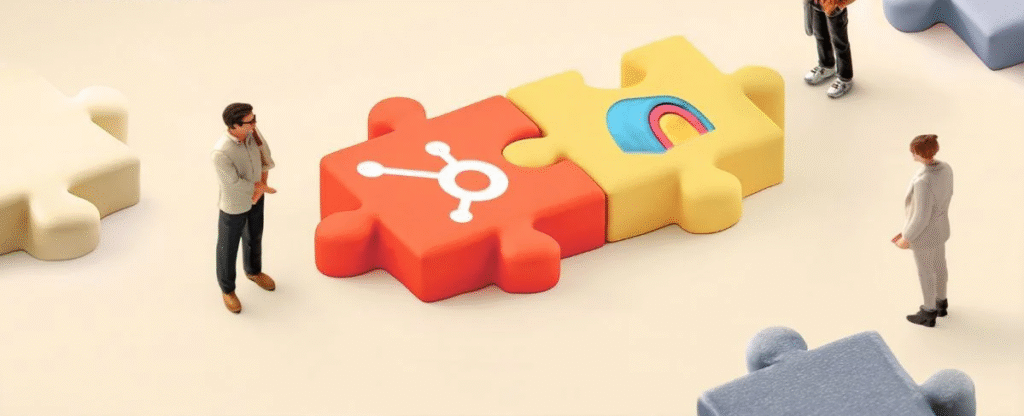
That’s when we began building the HubSpot Breeze + Clay stack, a unified workflow architecture that connects prospect data, marketing communication, and sales automation into one fluid ecosystem.
It wasn’t about adding another integration; it was about restoring flow to how marketing and sales teams operate. Breeze simplified the way teams configured HubSpot automations. Clay personalized how outreach scaled. And together, they created an intelligent layer where data didn’t just sync, it moved with purpose.
Today, the combination of HubSpot Breeze and Clay represents the next evolution in marketing and sales operations: a no-code bridge between CRM logic, contact intelligence, and real-time personalization. It’s how teams go from reactive to predictive, from follow-ups to foresight.
In this article, I’ll break down how this stack works, why it matters for scaling teams, and how to structure your setup using the Align → Automate → Achieve framework, the same methodology that’s helping organizations operationalize AI-powered client management with measurable ROI.
Because I believe, the companies that will lead tomorrow won’t just choose tools, they’ll operate intelligent systems that run their growth engine.
What this blog covers (short version):
HubSpot Breeze is the native AI layer within the HubSpot CRM platform that includes smart assistants, pre-built “agents,” and automated workflows.
Which part of the system?
How? Because Breeze sits directly within HubSpot, it uses your existing CRM data, workflows and context, no separate tool required. For example, you can prompt Breeze Assistant directly in the HubSpot UI to “summarize this account’s engagement” or “generate email drafts to this contact.”
This means your marketing, sales, and service teams can move from “open tool → export data → build message → upload” to “AI assistant inside HubSpot does it”, significantly reducing hand-offs and manual work.
Clay is a no-code data-workspace and enrichment platform designed to sync with CRMs like HubSpot, clean and enrich your records, and then push the improved data back into your system.
Which part of the system?
How? You connect your HubSpot account to Clay, select the objects/lists to enrich, apply enrichment workflows, then write the enriched fields back into HubSpot. For example: “Pull leads who match criteria X, enrich them with firmographics, update HubSpot property Y.”
Because Clay automates the data cleansing and enrichment part, it frees your teams from manual updates and ensures that the AI/agent workflows (like those in Breeze) have clean, high-signal data to act upon.
When you combine Breeze (the intelligent action layer) with Clay (the data identity/enrichment layer), you get a full stack: clean data → AI-driven actions → faster execution.
HubSpot + Clay articulates this exactly: HubSpot provides the growth platform; Clay ensures the underlying data is ready for AI to act.
In practice: Clay enriches and standardises the data that resides in HubSpot; Breeze uses that enriched data to trigger agents, workflows, and personalised content/actions. The result is growth workflows that are quicker, more consistent, and more scalable.
Dirty Data & Manual Overhead = Growth Friction
Many companies struggle with data quality: incomplete CRM records, missing fields, ambiguous lead scores. That forces manual enrichment, delays outreach, and reduces conversion. Clay addresses that pain point.
AI Agents Need Clean Data
Even the best agents fail when fed low-quality data. Breeze gets unlocked only when the underlying CRM data is enriched, structured and signal-rich. Clay provides that foundation.
Speed, Scale, Consistency
With Clay automating enrichment and Breeze automating workflows (agents trigger tasks, sequences, etc.), you get faster time-to-action, greater scale (more leads, more segments) and consistent execution rather than ad-hoc campaigns.
Fewer Tools, Lower Complexity
Instead of separate enrichment tools, CSV handoffs, manual uploads and standalone AI apps, you embed the stack: Clay → HubSpot → Breeze. One ecosystem.
Strategic Focus
Marketing and sales teams shift from “clean the data” and “build the list” to “design the strategy” and “optimize the pipeline”. The stack takes over the heavy lifting.
Integrating HubSpot + Breeze + Clay transforms how teams manage, sync, and act on customer data, removing the friction between CRM updates, workflow automation, and real-time insights.
The trio operates as a unified system: HubSpot acts as the core relationship engine, Breeze as the automation layer, and Clay as the intelligence workspace that connects data across tools.
Teams start by connecting their HubSpot account to Clay through the integration panel. This link allows Clay to securely access HubSpot’s CRM objects, i.e, Companies, Deals, Contacts, and Custom Objects, and map them to Breeze workflows.
Once connected, users define which objects or fields to sync. Clay uses unique identifiers such as HubSpot Object ID or company domain to ensure every record stays accurate and up to date across systems.
With the connection, active users can automatically create HubSpot records directly from within Clay.

Clay’s “Update Object” feature ensures that when data changes, like a deal moving stages or a contact updating their company details, it’s instantly reflected in HubSpot.

Two-way sync means Breeze automations can trigger Clay updates, and vice versa, keeping every system consistent. Teams can choose which fields to update while ignoring blank or non-essential data, protecting data integrity while maintaining flexibility.
Clay’s “Lookup Object” capability lets teams instantly pull existing HubSpot data into their Clay tables, whether it’s company history, deal progress, or contact engagement.

When Breeze automations run, they can query HubSpot through Clay to retrieve this context automatically, ensuring every workflow has full situational awareness.
This is especially powerful for sales and marketing teams that need instant insights before outreach or decision-making.
The integration supports all key HubSpot data types; Companies, Contacts, Deals, Leads, Owners, Contact Lists, and Custom Objects.

Data flows bidirectionally between Clay and HubSpot through Breeze’s automation engine, maintaining a live sync that keeps systems aligned.
Built-in safeguards, such as optional field mapping, selective sync rules, and overwrite prevention, ensure governance and control over what data gets changed.
Once workflows are active, users can track sync logs, data integrity, and automation performance inside Clay.
Breeze provides visibility into automation health and triggers, while HubSpot dashboards capture the resulting CRM metrics: conversion rates, deal velocity, and engagement trends.
As adoption grows, teams can expand the integration to new use cases, from automated onboarding sequences to customer lifecycle management.
Deploying Breeze + Clay isn’t just about connecting HubSpot to automation platforms, it’s about engineering a frictionless app setup and customer intelligence pipeline that makes your entire go-to-market ecosystem adaptive and insight-driven.
Without structure, even the most advanced integrations can become tangled in sync errors, data silos, and inconsistent workflows.
The Align → Automate → Achieve (AAA) Framework ensures Breeze + Clay doesn’t remain a convenience integration, but evolves into a strategic operating layer for your CRM, workflows, and customer personalization engine.
Before deploying automations, alignment ensures the right foundation; clarity on objectives, systems, and stakeholders.
Breeze + Clay can only streamline workflows that have been properly defined.
Define top business outcomes
Examples:
Audit your tech stack
Interview stakeholders
Design pilot workflows
Establish governance
Every department touches customer data, which makes Breeze + Clay adoption cross-functional by design.
Marketing
Sales
Customer Success (CS)
Operations / RevOps
Leadership Alignment Roles
Role | Core Contribution |
CMO / CRO | Defines business goals, approves automation outcomes |
Marketing Ops Lead | Manages tech stack mapping, connection governance |
RevOps / Data Engineer | Ensures data schema alignment between HubSpot and Clay |
Sales Manager | Validates enriched data quality, feedback loop for scoring |
CS Lead | Tracks retention metrics, adoption success, and app ROI |
By the end of Align, every stakeholder knows why Breeze + Clay matters, how it integrates into existing operations, and what ROI metrics to track from day one.
With alignment complete, it’s time to turn Breeze + Clay into a self-sustaining automation ecosystem.
Workflow Intelligence Mapping
Deployment
Iteration & Monitoring
Training & Calibration
Feature | What It Does | Why It Matters |
Unified App Setup (Breeze) | One-click setup to link HubSpot with Clay, Notion, or Airtable | Eliminates long onboarding and manual API key entry |
Dynamic Contact Enrichment (Clay) | Pulls company, title, location, tech stack, and funding data | Increases lead scoring precision and outreach relevance |
Automated Routing (Breeze) | Routes qualified leads to right reps with conditions | Reduces SDR manual sorting by up to 60% |
Error & Retry Logic | Detects failed syncs, retries automatically | Improves automation reliability and trust |
Real-Time Alerts & Dashboards | Visualize flow performance, enrichment accuracy, and sync uptime | Gives executives transparency into system ROI |
By the end of this phase, your CRM automation engine evolves from manual orchestration to intelligent self-management, while your teams move from repetitive admin work to performance analysis and optimization.
The “Achieve” phase is where Breeze + Clay stops being a productivity hack, and starts becoming an infrastructure layer of your RevOps system.
Deploy Dashboards & KPIs
Monitor Adoption & Usage
Continuous Improvement Loops
Scale Across Teams
Embed the “Human-Plus-Automation” Mindset
In 10 weeks, Breeze + Clay transforms your app setup process from a patchwork of tools into a cohesive, intelligent automation ecosystem.
You’ll move from:
In the same way that marketers once dreamed of “one tool to rule all social channels”, growth teams now dream of “one pipeline from raw data to closed won” that requires minimal manual intervention.
HubSpot Breeze + Clay delivers that vision: clean data, automated enrichment, intelligent agents; all stitched together inside your CRM ecosystem.
But tools alone aren’t enough. The real multiplier is your process: how you align stakeholders, automate the stack, and embed it into your growth motion.
That’s why the AAA framework matters.
Deploy this stack thoughtfully, measure the results, iterate rapidly, and you’ll shift from manual-heavy growth to intelligence-driven acceleration.
Your tech stack becomes not just a set of tools, but a growth engine.
Ready to turn your CRM from a data store into a growth engine?
🚀 Free Resource: Download our free Leading AI-Enhanced Teams Resource.
📅 Complimentary AI Strategy Session: Book a session to identify your highest-impact Breeze + Clay pilot and accelerate ROI.
Because now, the future of growth isn’t tool proliferation, it’s orchestration. With HubSpot Breeze + Clay, you don’t just adapt to the future. You build it.