
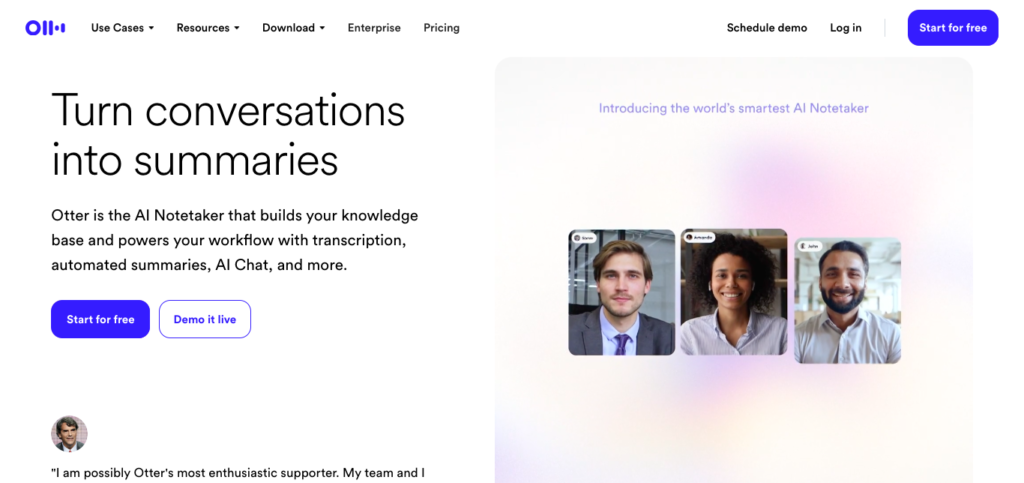
Modern teams spend a significant portion of their time in conversations.
Work unfolds across Zoom calls, internal syncs, sales demos, interviews, planning workshops, and stakeholder discussions. These conversations contain decisions, context, commitments, and intent that directly shape execution. Yet much of this intelligence fails to carry forward once the meeting ends.
Notes are often partial or inconsistent. Action items are captured unevenly. Decisions live in individual memories rather than shared systems. Follow-ups rely on manual recall and extra coordination.
Most collaboration tools support scheduling, recording, or task tracking, but they leave a critical gap between conversation and execution. Audio may be captured, calendars may log attendance, and tasks may be tracked elsewhere, but the substance of what was said often remains unstructured and difficult to reuse.
This gap is where Otter.ai becomes relevant.
Otter embeds intelligence directly into the conversation layer of work; meetings, discussions, interviews, and spoken collaboration.
Rather than asking teams to “summarize meetings later,” Otter brings AI into the moment work happens:
Transcribing conversations in real time
Identifying speakers and key points
Generating structured summaries
Extracting action items and decisions
Creating a searchable memory of organizational conversations
In 2026, as organizations operate with fewer meetings but higher expectations for execution, Otter.ai becomes a practical intelligence layer, one that converts talk into action without adding overhead.
In this article, I’ll break down:
What Otter.ai actually is (and what it is not)
Why it matters in today’s execution-heavy environments
How Otter.ai works inside real workflows
Who benefits most (with concrete use cases)
How to adopt it using our Align → Automate → Achieve framework so meeting intelligence doesn’t remain fragmented or unused
Because the teams that scale are the ones that retain, operationalize, and act on what was said. And Otter.ai is built for exactly that.
At its core, Otter.ai is an AI-powered meeting intelligence platform designed to capture, structure, and operationalize spoken conversations.
Unlike traditional transcription tools that simply convert audio to text, Otter.ai works in context:
Inside live meetings
Across recurring conversations
Within shared team workspaces
Tied to speakers, timestamps, and meeting metadata
This makes it fundamentally different from generic note-taking or recording tools.
Real-time AI transcription
Otter captures conversations live, identifying speakers and producing time-stamped transcripts that update as the meeting unfolds.
AI-generated summaries
After meetings, Otter produces structured summaries highlighting:
Key discussion points
Decisions made
Action items
This reduces the need for manual recap writing.
Searchable conversation memory
All meetings become searchable by keyword, speaker, or phrase, turning conversations into a long-term organizational knowledge base.
Collaboration inside transcripts
Teams can:
Highlight key moments
Add comments
Share transcripts across stakeholders
Meeting platform integration
Otter integrates directly with tools like Zoom, Google Meet, and Microsoft Teams, allowing it to join meetings automatically and capture conversations without manual setup.
In short, Otter.ai is not about “recording meetings.” It’s about making conversations usable, retrievable, and actionable by default.
Most organizations already meet constantly. What’s missing is systematic retention and interpretation of what happens inside those meetings.
Teams spend hours every week:
Rewriting meeting notes
Clarifying decisions post-call
Following up on forgotten action items
Searching Slack or email for “what was agreed”
These are not strategic tasks, but they consume strategic time.
Otter.ai directly targets this gap.
Instead of: Humans remembering → summarizing → clarifying → following up
You get: Systems capturing → structuring → surfacing → reinforcing action
This creates leverage.
Several macro trends make Otter.ai especially relevant now:
Increase in remote and hybrid meetings
Growing volume of verbal collaboration across teams
Demand for documentation without administrative burden
Need for searchable institutional memory
Pressure to reduce meeting overhead while improving execution
Otter.ai sits at the intersection of productivity, accountability, and knowledge retention.
Otter.ai has reached over 35 million users worldwide as of 2025, signaling strong penetration across professional, educational, and enterprise environments. This scale reflects sustained demand for AI-driven meeting intelligence beyond early adopters.
In early 2025, Otter.ai surpassed $100 million in annual recurring revenue (ARR), achieved with a lean team of fewer than 200 employees. This milestone highlights both product-market fit and operational efficiency, particularly in enterprise and team-based deployments.
Otter.ai is deeply integrated into Zoom, Google Meet, and Microsoft Teams workflows, positioning it as a default layer in remote-first and hybrid collaboration environments. Its visible “meeting participant” model reflects how organizations increasingly expect AI to operate inside live work systems rather than as post-meeting tools.
By 2025, automated transcription and summarization have shifted from optional enhancements to baseline productivity expectations. Otter.ai’s continued user growth, from approximately 14 million users in 2023 to over 25 million+ by 2025, demonstrates accelerating adoption driven by this shift.
Organizations are increasingly treating spoken conversations as durable knowledge assets. Otter.ai’s evolution into AI meeting agents that can answer questions, extract decisions, and support follow-ups reflects a broader trend: conversations are no longer ephemeral; they are searchable, referenceable, and operational.
Scale confirms maturity: Tens of millions of users and $100M+ ARR indicate Otter.ai is no longer an experimental tool; it is an established collaboration platform.
Enterprise confidence is rising: Strong revenue growth and expansion into AI agents show organizations are investing beyond transcription into active meeting intelligence.
Meeting intelligence is now infrastructure: As conversations become structured data, tools like Otter.ai form a foundational layer for execution, accountability, and institutional memory.
This positions Otter.ai as a meeting intelligence and execution support platform.
These features make Otter.ai an augmentation layer, not a replacement for human judgment.
A typical Otter.ai workflow looks like this:
A meeting begins: Otter joins automatically or records audio.
Conversation is captured live: Speech is transcribed with speaker labels and timestamps.
AI structures the conversation: Summaries, highlights, and action items are generated.
Teams review and act: Humans focus on decisions and follow-through, not recall.
This loop runs continuously, without note-taking, without copy-pasting, without post-meeting confusion.
Adopting Otter.ai is not about recording more meetings. It is about establishing a reliable intelligence layer for how decisions, commitments, and knowledge move through the organization.
Most teams already talk enough. The real challenge is that spoken decisions, context, and intent are scattered across calls, notes, chats, and memory. Without a structured operating model, Otter.ai risks becoming just another transcript repository; useful, but disconnected from execution.
To generate sustained value, Otter.ai must be embedded directly into how teams run meetings, extract outcomes, and operationalize follow-through.
The AlignAI.dev Align → Automate → Achieve framework provides that structure. It moves Otter.ai from passive documentation to an active system that captures, distributes, and reinforces what was agreed—consistently, at scale.
When implemented correctly, Otter.ai becomes part of organizational muscle memory: conversations are captured accurately, actions are made explicit, and institutional knowledge compounds instead of disappearing.
Before Otter.ai transcribes a single meeting, teams must align on what intelligence matters, who consumes it, and how it drives execution.
Otter.ai amplifies clarity only when expectations and workflows are clearly defined.
1. Define meeting intelligence outcomes & success metrics
Otter.ai works best when outcomes are concrete and tied to execution improvement.
Examples of outcomes:
“Ensure every meeting produces clearly documented decisions and action items.”
“Reduce follow-up confusion and rework caused by misaligned understanding.”
“Create a searchable knowledge base of internal conversations.”
“Shorten project cycle times by improving post-meeting accountability.”
“Improve onboarding by preserving institutional context from past discussions.”
This step ensures Otter.ai supports execution, not just documentation.
2. Audit the current meeting & follow-up ecosystem
Most organizations already have informal systems for meeting notes and follow-ups. These must be surfaced before Otter.ai is introduced.
Audit:
Manual note-taking practices (Docs, Notion, personal notes)
Missed or unclear action items
Decisions shared verbally but not recorded
Follow-ups tracked via chat or email
Knowledge lost when employees change roles or leave
This exposes where Otter.ai can consolidate and standardize meeting intelligence.
3. Stakeholder interviews across functions
Meeting pain rarely shows up in tooling audits. It shows up in conversations.
Interview:
Product → decision clarity, backlog alignment, roadmap discussions
Marketing → campaign planning, approvals, cross-team syncs
Sales → discovery calls, demos, deal handoffs
Operations → coordination meetings, SOP reviews
Customer Success → onboarding calls, renewals, escalations
Leadership → visibility into decisions, risks, and commitments
Common themes uncovered:
“We remember meetings differently.”
“Action items get lost.”
“We repeat the same conversations.”
“Context disappears after the call.”
4. Select high-leverage pilot use cases
Avoid company-wide rollout. Start where conversational intelligence has the highest return.
Examples:
Weekly leadership syncs
Product discovery and sprint planning
Sales discovery and demo calls
Client onboarding or QBRs
Cross-functional project meetings
The objective is trust and consistency, not coverage.
5. Establish governance & usage principles
Otter.ai’s strength depends on disciplined usage.
Define:
Which meetings are auto-recorded
Who can access transcripts and summaries
How action items are validated
Privacy and consent standards
Naming conventions and meeting tagging
Where Otter outputs are stored or referenced
This prevents transcript sprawl and ensures long-term usability.
Product & Engineering
Pain: Lost context from discovery and planning meetings
Impact: Persistent decision trails and rationale
Use Case: “Product Discovery & Sprint Intelligence”
Sales & Revenue Teams
Pain: Missed signals and inconsistent follow-ups
Impact: Clear summaries, next steps, objection tracking
Use Case: “Sales Call Intelligence & Follow-Through”
Marketing
Pain: Campaign decisions scattered across meetings
Impact: Documented approvals and execution clarity
Use Case: “Campaign Planning Intelligence”
Operations
Pain: Manual coordination and misalignment
Impact: Clear commitments and ownership
Use Case: “Operational Sync Intelligence”
Leadership
Pain: Limited visibility into real discussions
Impact: Read-only summaries and decision logs
Use Case: “Executive Meeting Intelligence”
CEO / Executive Sponsor: Sets expectations for meeting discipline and accountability
COO / Ops Lead: Owns adoption consistency and governance
Department Heads: Enforce usage in team rituals
PMO / Change Lead: Drives training and feedback loops
IT / Security: Ensures compliance and access controls
Outcome of Align: By the end of this phase:
Teams know which meetings matter
Success metrics are defined
Pilot use cases are selected
Governance is established
Otter.ai has a clear operational role
With alignment in place, Otter.ai is operationalized as a live intelligence layer, not a passive archive.
This is where conversation data becomes structured, searchable, and actionable.
1. Meeting capture & intelligence mapping
Configure Otter.ai to:
Auto-join selected meetings
Identify speakers accurately
Capture key moments, decisions, and questions
Generate structured summaries
Define what matters:
Decisions
Action items
Commitments
Risks
Open questions
2. Structured summaries & action workflows
Ensure summaries follow consistent formats:
What was discussed
What was decided
Who owns what
What happens next
Connect outputs to:
Task systems
Project trackers
CRM notes
Knowledge bases
3. Insight distribution
Automate delivery of meeting intelligence:
Summaries sent to attendees
Action items routed to owners
Decision highlights shared with leadership
Client summaries delivered post-call
The goal is zero manual follow-up.
4. Training & calibration
Teams learn:
How to validate AI-generated summaries
How to correct or clarify action items
How to reference Otter records instead of re-asking questions
How to search past conversations effectively
5. Continuous iteration
Monitor:
Which meetings produce value
Where summaries are ignored
Where manual notes persist
Where follow-through breaks down
Refine:
Summary formats
Meeting scopes
Distribution rules
Outcome of Automate:
Meetings generate usable intelligence
Action items are explicit and traceable
Context is preserved across time
Teams rely less on manual notes
This phase institutionalizes Otter.ai as the default post-meeting execution system.
Deploy intelligence dashboards
Meeting volume vs outcomes
Action item completion rates
Decision turnaround times
Repeated topics or blockers
Monitor adoption and quality
Meeting coverage
Summary usage
Action follow-through
Search behavior
Identify execution improvements
Faster decisions
Fewer clarification meetings
Reduced rework
Better onboarding outcomes
Scale across the organization
HR interviews and onboarding
Client delivery and renewals
Internal initiatives
Training and enablement
Embed the “conversation as data” mindset
Meetings become inputs, not endpoints
Decisions are referenced, not debated repeatedly
Accountability is documented by default
Within 8–10 weeks:
Otter.ai becomes embedded in daily work
Meeting intelligence stops evaporating
Teams trust summaries and action items
Leadership gains visibility into real conversations
Execution becomes clearer and more consistent
Otter.ai evolves from a transcription tool into a conversation intelligence backbone, one that ensures what is said actually drives what gets done.
This framework ensures Otter.ai does not become:
A passive transcript archive
Another unused productivity tool
A privacy concern
Instead, it becomes:
A meeting intelligence system
An execution support layer
A knowledge retention engine
A scalable operating model
If your team:
Runs frequent meetings
Loses decisions to memory gaps
Rewrites notes manually
Struggles with follow-through
Otter.ai is a practical, scalable choice.
Start with one meeting type. Build trust. Scale deliberately.
Book a 30-minute Complimentary AI Strategy Session, and let’s identify where Otter.ai can reduce meeting friction, preserve decisions, and improve execution, without changing how your teams already meet.
If you’re a product leader, operations manager, or revenue team navigating conversation overload, Otter.ai can become your embedded meeting intelligence layer.

