
Modern teams are not struggling with a lack of data.
They’re struggling with too much data, spread across tools, formats, and workflows that require constant human interpretation.
Spreadsheets hold information but don’t understand it.
Dashboards show numbers but don’t explain them.
Traditional project tools track tasks but don’t help teams reason, summarize, or decide faster.
This is where Airtable’s AI capabilities change the equation.
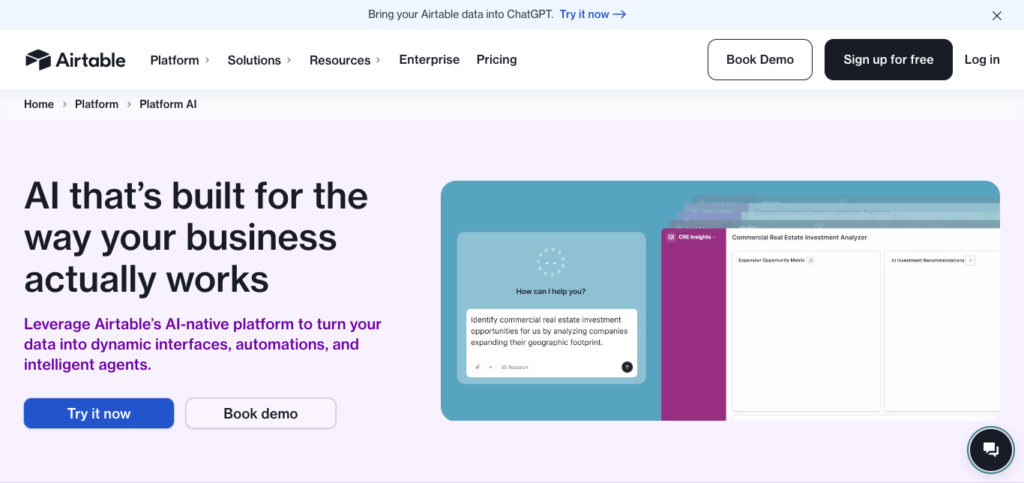
Airtable AI is not positioned as a standalone chatbot or a generic assistant. Instead, it embeds intelligence directly into the systems where work already lives; tables, records, workflows, and automations.
Rather than asking teams to “go talk to AI,” Airtable brings AI into the flow of work:
Summarizing project updates
Generating structured content from raw inputs
Extracting insights from records
Cleaning, classifying, and enriching data
Supporting faster decisions without context-switching
In 2026, as organizations face mounting pressure to move faster with fewer resources, Airtable AI becomes a practical intelligence layer, one that augments execution instead of distracting from it.
In this article, I’ll break down:
What Airtable AI actually is (and what it is not)
Why it matters in today’s execution-heavy environments
How Airtable AI works inside real workflows
Who benefits most (with concrete use cases)
How to adopt it using our Align → Automate → Achieve framework so AI doesn’t end up as a novelty feature no one trusts
Because the teams that scale are not the ones with the most data.
They’re the ones that can interpret, act on, and operationalize data fastest.
And Airtable AI is built for exactly that.
Also read: Airtable: The Project Management Engine Your Team Can Run Now
At its core, Airtable AI is a set of embedded AI capabilities designed to help teams generate, summarize, classify, extract, and reason over structured data directly inside Airtable bases.
Unlike external AI tools that operate on isolated prompts, Airtable AI works within context:
Inside records
Across tables
Within automations
Tied to permissions, workflows, and ownership
This makes it fundamentally different from generic AI assistants.
Key characteristics of Airtable AI include:
AI at the field level
You can create AI-powered fields that:
Summarize multiple records
Generate text from structured inputs
Classify or tag data automatically
Normalize inconsistent entries
AI actions inside automations
AI steps can be triggered when:
Records are created or updated
Forms are submitted
Statuses change
Deadlines approach
This enables intelligence to run continuously, not manually.
Context-aware generation
Because Airtable AI understands table structure, linked records, and field types, outputs are more structured and usable than free-form chatbot responses.
Governed, enterprise-ready deployment
AI usage respects:
Role-based permissions
Data boundaries
Workspace-level governance
This is critical for teams operating in regulated or high-stakes environments.
In short, Airtable AI is not about “asking questions.”
It’s about making your operational system smarter by default.
Most organizations already track tasks, projects, and data exhaustively.
What’s missing is interpretation at scale.
Teams spend hours every week:
Writing status updates
Summarizing progress
Cleaning messy inputs
Categorizing requests
Extracting insights from raw records
These are not strategic tasks, but they consume strategic time.
Airtable AI directly targets this gap.
Instead of:
Humans summarizing → then reporting → then acting
You get:
Systems summarizing → flagging → prompting action
This creates leverage.
Several macro trends make Airtable AI especially relevant now:
Explosion of operational data across marketing, product, ops, and customer teams
AI fatigue from disconnected tools that don’t integrate into workflows
Demand for governed AI that respects data ownership and access control
Rise of no-code intelligence, where non-technical teams deploy AI safely
Airtable AI fits squarely at this intersection: intelligence without chaos.
Large global user base: As of 2025, Airtable serves over 450,000 organizations worldwide, showing broad adoption across industries and use cases. SQ Magazine
Enterprise growth and retention: Airtable’s enterprise customers demonstrate strong engagement, with net dollar retention around 170%. SQ Magazine
Rapid expansion of automated workflows: Between 2024–2026, the number of automated workflows created in Airtable rose by about 60%, indicating a strong shift toward automation within the platform. Fueler
AI-driven productivity gains: Organizations leveraging Airtable’s embedded AI capabilities report significant improvements, e.g., up to 66% better efficiency in data analysis and 90% reduction in manual data entry. SQ Magazine
Low-code/no-code market momentum: By 2025, it’s projected that 70% of new enterprise applications will use low-code or no-code platforms, underscoring the mainstream role these tools play in internal application development. UserGuiding
Cost & development advantages: Low-code tools like Airtable can enable projects to be built up to 10× faster than traditional development approaches, reducing cycle times and enabling faster delivery. BrowserCat
Broad adoption signals maturity: Serving hundreds of thousands of organizations globally shows Airtable is a widely accepted workspace and project tool.
High enterprise retention suggests stickiness: A strong net dollar retention (~170%) implies that larger teams continue expanding usage and deriving value over time.
Automation usage is growing quickly: A 60% rise in workflow automation usage indicates teams are automating repeatable work, a key advantage for project delivery and operational efficiency.
AI integration delivers measurable productivity gains: Where embedded AI reduces manual work and speeds analysis, organizations can reallocate human resources to higher-value project planning and decision-making.
No-code future is now: With the majority of new applications expected to be built using low-code/no-code platforms by 2025, adopting tools like Airtable aligns with a broader industry shift toward democratized development and rapid prototyping.
Faster delivery at lower cost: The dramatic improvements in time-to-value (10× faster delivery, far lower development overhead) directly support project management goals; faster launches, fewer dependencies, and reduced engineering bottlenecks.
This positions Airtable as a team collaboration and project orchestration platform.
These features make Airtable AI an augmentation layer, not a replacement for human judgment.
A typical Airtable AI workflow looks like this:
Data enters the system
Via forms, integrations, APIs, or manual updates.
AI processes the data in context
Summarizes text, classifies records, extracts insights, or generates structured outputs.
Automations trigger actions
Notifications, status updates, record creation, or escalations.
Humans review, decide, and act
AI reduces noise; humans focus on decisions.
This loop runs continuously, without prompting, without copy-pasting, without meetings.
Deploying AirtableAI is about giving teams a shared, flexible system of record where projects, tasks, dependencies, timelines, and ownership live together; and stay accurate.
Without a structured approach, most Airtable AI implementations suffer one of two fates:
They become overbuilt, chaotic bases no one trusts
Or they remain lightweight pilots that never scale beyond one team
The Align → Automate → Achieve framework ensures Airtable AI evolves into a central project operating system in your company, one that adapts to how teams actually work while maintaining clarity, governance, and execution discipline.
Before enabling AI fields or automations, organizations must align on where intelligence actually adds value.
Key Activities
1. Define AI-appropriate use cases Airtable AI works best for:
Summarization
Classification
Pattern extraction
First-draft generation
Examples:
“Summarize weekly project updates automatically.”
“Classify inbound requests by urgency.”
“Generate executive-ready briefs from raw inputs.”
2. Audit data readiness Assess:
Which tables contain high-signal text
Where data quality is inconsistent
Which workflows rely on manual interpretation
3. Identify trust boundaries Decide:
Where AI can act autonomously
Where human review is required
What outputs are advisory vs authoritative
4. Design pilot AI workflows Start small:
AI-generated project summaries
AI-tagged intake forms
AI-cleaned notes fields
Outcome of Align: Clear scope, clear guardrails, realistic expectations.
With alignment in place, teams operationalize Airtable AI inside real workflows.
Core Execution Layers
1. AI Field Deployment Create AI-powered fields for:
Summaries
Classifications
Generated descriptions
Extracted insights
2. AI-Driven Automations Trigger AI when:
Records are created
Status changes occur
Deadlines approach
Forms are submitted
3. Review & Calibration Continuously refine:
Prompts
Field logic
Automation conditions
4. Team Enablement Train teams to:
Interpret AI outputs
Correct edge cases
Improve inputs over time
Outcome of Automate: AI shifts from novelty to operational support.
This phase institutionalizes Airtable AI as a trusted intelligence layer.
1. Measure impact Track:
Time saved
Reduction in manual summaries
Data consistency improvements
Decision latency
2. Scale across workflows Expand to:
Marketing ops
Product delivery
Customer insights
Internal reporting
3. Embed the “AI-assisted execution” mindset Humans focus on:
Judgment
Prioritization
Strategy
AI handles:
Synthesis
Cleanup
Pattern recognition
This framework ensures Airtable AI does not become:
Another abandoned workspace
A messy spreadsheet replacement
A siloed team tool
Instead, it becomes:
A project execution system
A visibility engine
A coordination layer
A scalable operating model
If your team:
Manages high volumes of text or updates
Spends time summarizing instead of deciding
Struggles with inconsistent inputs
Needs intelligence embedded in workflows, not in chat tools
Airtable AI is a practical, scalable choice.
Start with one workflow.
Prove trust.
Scale deliberately.
Book a 30-minutes Complimentary AI Strategy Session, and let’s identify where Airtable AI can reduce manual interpretation, improve data quality, and accelerate decisions, without disrupting how your teams already work.
If you’re a product leader, operations manager, or growth team navigating data-heavy workflows and interpretation overload, Airtable AI can become your embedded intelligence layer.

