
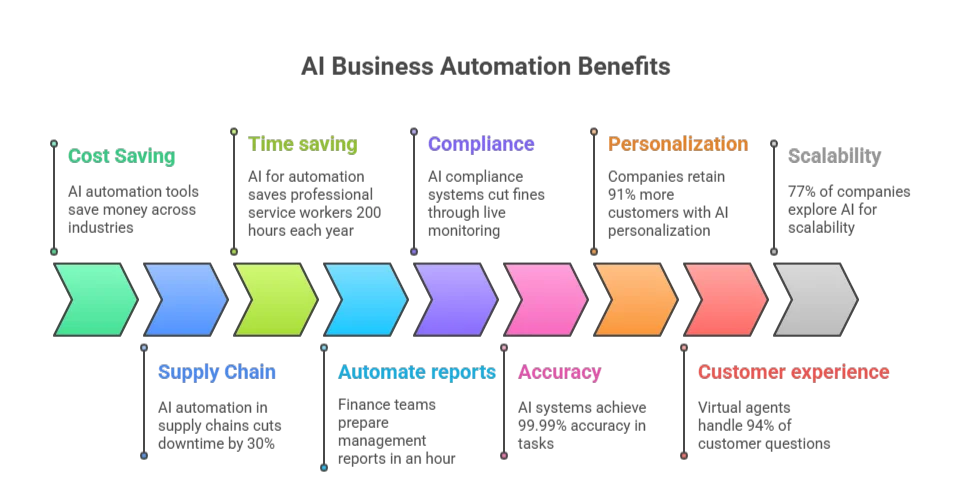
Artificial Intelligence (AI) has transformed from a futuristic concept into a core operational force across industries in 2025. Businesses no longer view AI as a mere experiment or productivity booster; they rely on it to fully automate tasks, optimize workflows, and unlock tangible value.
And now, AI is embedded in every part of the enterprise, from sales and marketing to finance, HR, operations, and client success, redefining how teams work, make decisions, and deliver results.
At AlignAI.dev, we’ve seen firsthand how AI can turn time-consuming manual tasks into fully autonomous processes. Our clients reclaim dozens of hours per employee each month, enabling teams to focus on strategy, creativity, and human-centric activities that drive growth.
The impact is measurable: companies deploying agentic AI solutions see accelerated cycles, improved operational efficiency, higher employee satisfaction, and significant revenue growth.
But automation, along with being about speed, is also about scaling human potential as well. By offloading repetitive, predictable, or administrative work to AI, organizations gain the bandwidth to innovate, respond faster to market changes, and provide higher-quality experiences to customers and employees alike.
In this blog we cover:
15+ tasks businesses have successfully automated with AI in 2025
Quantified impacts and outcomes
Proven use cases from real companies
Before diving into use cases, it’s important to clarify what “fully automated” means in this context:
Full automation refers to workflows where AI is responsible for the end‑to‑end execution of a task or series of tasks, with minimal human intervention. This includes:
Unlike simple scripts or macros that only speed up manual tasks, full automation involves systems that can:
Trigger automatically, based on events or schedules
Perform multi‑step processes with conditional logic
Integrate with enterprise systems such as CRM, ERP, HRIS, and support platforms
Generate outputs or take actions based on data analysis, business rules, or learned patterns
Log results and provide feedback for review, measurement, and refinement
Full automation is not limited to specific tools; it requires combining AI with workflow orchestration, system integration, and governance standards. It is most effective when systems are:
Connected to data sources (e.g., databases, CRM records, logs, telemetry)
Linked to execution systems (e.g., email platforms, messaging, ticketing, scheduling)
Monitored for quality and reliability
Evaluated using measurable KPIs such as hours saved, error rates, cycle times, and stakeholder satisfaction
These automations are measurable, repeatable, and integrated into core business systems.
Below are detailed examples of tasks companies have fully automated in 2025, with context, outcomes, and references wherever available.
At AlignAI.dev, every sales rep uses agentic AI to automate:
Lead qualification and scoring using predictive AI models
Prioritization of outreach based on deal likelihood
Automated follow-ups via email/chat sequences
CRM updates without manual entry
Prospect scheduling with AI calendar integration
Pipeline forecasting with real-time insights
KPI tracking dashboards are updated automatically
Impact: Each rep reclaims ~40 hours/month. For a 10-person team, this adds up to 400 hours/month, equivalent to 2.5 additional FTEs.
Sales cycles move 57% faster, revenue grows by 20–6,000%, and employee satisfaction improves 20%.
AlignAI.dev automates marketing functions through:
AI-driven content generation (blogs, social posts, creatives)
Campaign scheduling and automation across channels
Dynamic campaign optimization with AI recommendations
Project management dashboards for marketing operations
Real-time performance analytics and reporting
Automating repetitive approvals and task allocation
Optimizing workflows to reduce bottlenecks
Impact: Teams reclaim 38 hours/week or ~152 hours/month, equivalent to a full-time team member. Marketers focus on high-value strategy and creativity.
AlignAI.dev has implemented AI for operations with:
Project & resource planning automation
Workflow optimization across business units
Task and project management with AI reminders and tracking
Data entry and automated report generation
Real-time analytics dashboards for operational insights
Predictive scheduling and workload balancing
AI‑assisted process improvement recommendations
Impact: Teams save 42 hours/week, eliminating 69% of repetitive work, while operations run smoothly and autonomously.
HR workflows fully automated at AlignAI.dev:
Candidate sourcing and AI-driven screening
Interview scheduling and coordination
Onboarding automation for new hires
Training and compliance tracking with AI
HR analytics dashboards for workforce planning
Employee satisfaction and engagement monitoring
Payroll and benefits management automation
Impact: HR teams reclaim 39 hours/week, enabling more strategic, human-focused work like culture building and engagement programs.
Finance teams at AlignAI.dev leverage AI to:
Reconciliation automation
Invoice and expense processing
Forecasting and financial reporting
Compliance and audit preparation
Workflow and task automation
KPI dashboards updated in real-time
Exception handling for anomalies via AI alerts
Impact: 47 hours saved per week, equivalent to one full-time finance professional, reducing errors and freeing teams for strategic planning.
AlignAI.dev automates client-facing operations:
Customer support triage and ticket routing
Surveys and sentiment analysis automation
Outreach and engagement sequences
Renewal & upsell tracking
Ticket resolution workflows
Onboarding and training programs
SLA reporting and performance monitoring
Impact: 40 hours saved/week, equivalent to one full-time Customer Success Manager. Client-facing teams now focus on high-touch relationships, while AI handles the backend.
Across industries, AI systems categorize and respond to customer queries automatically, reducing load on live agents. Support managers report 50%+ faster ticket routing and higher customer satisfaction when AI handles initial triage. LinkedIn
Companies deploy AI helpdesk bots that resolve internal requests, from password resets to policy insights, with autonomous responses, saving tens of thousands of employee hours annually.
Large enterprises are automating complex financial workflows using integrated AI and intelligent document processing (IDP). For example, process automation can reduce expense processing times by over 80%, cutting errors and freeing staff for strategic work. arXiv
Omega Healthcare implemented AI document processing to handle medical billing, denial letters, and insurance claims, saving over 15,000 employee hours per month and reducing documentation time by 40% with 99.5% accuracy. Business Insider
E‑commerce leaders like Amazon use robots and AI to automate sorting, picking, and transportation in warehouses, achieving significant cost reductions and throughput increases. Omega Consulting
AI systems can continuously monitor business processes, documents, and activities to detect regulatory or internal policy violations in real time and automatically generate alerts or reports. This approach replaces periodic manual audits with ongoing oversight, allowing issues to be flagged and addressed immediately rather than after the fact. Real-time compliance monitoring scales across large datasets, reduces manual effort, and helps organizations stay audit-ready while meeting evolving regulatory requirements. strikegr
Retailers and logistics companies leverage AI forecasting to automate inventory replenishment, reduce waste, and keep supply chains agile by anticipating demand shifts. Silicon IT Hub
AI tools can review contracts and legal documents at scale, for example, automating due diligence or compliance reviews, reducing cycle times and risk. Marketing Scoop
AI summarizes meeting notes, extracts decisions, and updates CRMs or task boards automatically, saving administrative hours and boosting information flow across organizations. minute-call.com
From these examples, several patterns emerge:
AI excels in repetitive, rule‑based, and high‑volume tasks, freeing human workers for strategic thinking.
Integrations matter: AI works best when connected directly to core systems such as CRM, ERP, or HR platforms.
Measurement is essential: Track hours saved, error rates, cycle times, and quality improvements to quantify ROI.
Human oversight remains critical: AI handles execution, humans handle exceptions, strategy, and ethics.
AI adoption and its measurable impact on productivity, cost reduction, and business outcomes are being documented across markets, industries, and functions.
Below are key current statistics for 2025 demonstrating how widespread, impactful, and economically significant AI automation has become:
78% of companies worldwide are using AI in at least one business function, up markedly from earlier years and showing rapid penetration across industries. geniusaitech.com
Generative AI usage is widespread, with 71% of organizations integrating GenAI tools into their workflows, often in customer service, content generation, and internal automation. geniusaitech.com
Large enterprises are particularly active: Fortune 100 firms report AI use in 2+ functions by a significant majority. The Global Statistics
In 2025, AI adoption is associated with productivity increases of 26–55% across various functions when implemented strategically and supported with governance. Fullview
Businesses using AI report efficiency improvements, cost reductions, and revenue impact averaging 6–10%, with some sectors observing cost drops of up to 60%. GizmoBase
One study estimates that AI‑enabled automation can save up to $150 billion annually for businesses through reduced workload on repetitive tasks. geniusaitech.com
Reports indicate a strong average return on investment (ROI) from AI, roughly $3.70 for every $1 invested, making automation a compelling strategic investment. geniusaitech.com
Nearly 80% of businesses plan to increase AI investment by 2026, with automation prioritized to deliver measurable operational value. krishangtechnolab.com
Although adoption rates are high, only a small percentage (around 1%) of organizations describe GenAI implementations as fully mature, underscoring the need for structured governance and scaling strategies. Kenility
A significant skills gap persists, with many organizations investing in training to translate AI adoption into measurable performance improvements. Kenility
AI is no longer limited to back‑office functions; process automation, customer service, analytics, and content creation are among the most common automation categories reported by businesses. GizmoBase
Some surveys show AI automating as much as 40% of the average workday, significantly reducing manual hours in routine business tasks. Adoptify
Retail, IT & telecom, healthcare, and financial services show high AI deployment rates, with manufacturing reporting over 77% adoption in production operations by 2025. Netguru
Industries with high automation impact include predictive maintenance in manufacturing, AI‑driven fraud detection in finance, and customer support automation across sectors. Netguru
To ensure automation delivers real value, companies should track:
As we move into 2026, AI automation drives speed, efficiency, and growth for businesses ready to lead. By automating repetitive workflows today, companies are setting themselves up to start 2026 with a massive productivity advantage.
From document processing that saves thousands of hours, to AI-driven customer support triage and autonomous operational systems, the businesses that adopt AI now will enter next year with teams focused on strategy, innovation, and high-value outcomes, not mundane tasks.
At AlignAI.dev, we design automation solutions that integrate seamlessly into your existing workflows, measure impact rigorously, and enhance capacity across Sales, Marketing, Operations, HR, Finance, and Client Success.
By starting now, you can accelerate 2026, turning AI-led automation into measurable, scalable, and business-driving results from day one.
If you want to kickstart 2026 with AI that delivers real impact, we invite you to:
📘 Download our practical guide for leaders building high‑impact AI workflows
📅 Book a complimentary 30‑minute AI Strategy Session to explore tailored automation opportunities
When AI automates the work that slows you down, your team will get the time and focus to innovate, serve customers, and grow.


