
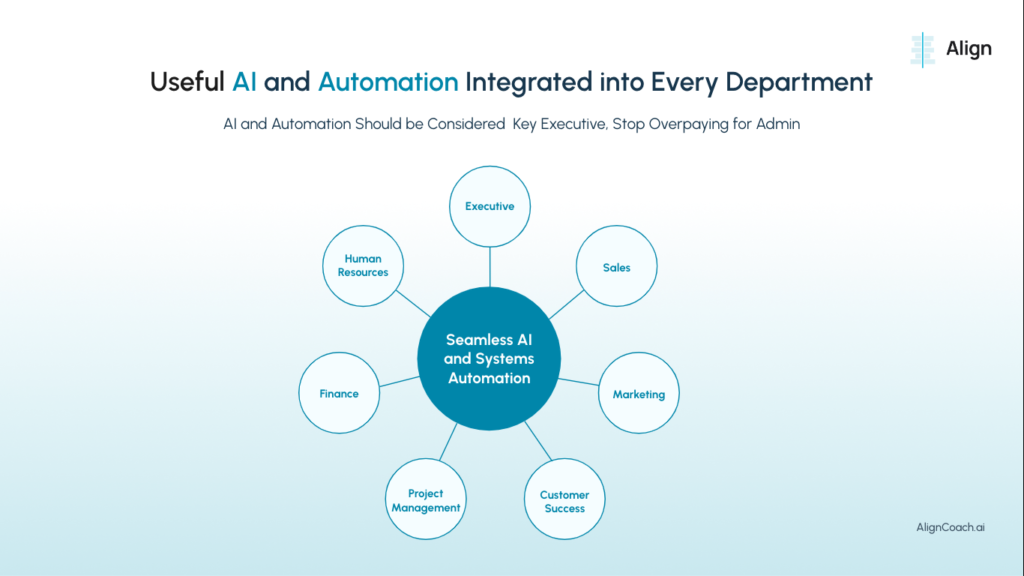
How AlignAI.dev Built a Culture Where Replacing Yourself Rewarded
AI Automation is often an aspect employees feel disconnected from, although it’s a core workplace competency. Companies everywhere are seeking efficiency, speed, and scale, yet many still rely on mostly manual work.
AI Automation is often treated as one time projects instead of a continuous responsibility. Efficiency should come from intentional systems and not hope or motivation alone.
At AlignAI.dev, every team member, regardless of role or seniority, has a KPI Goal to automating one or more of their responsibilities each month. This KPI is a win for everyone: it reduces manual workloads, increases employee satisfaction, keeps workweeks at 40 hours, and frees up employees to be in the zone of their genius. Automation is embedded into operations and daily work rather than left as an optional or occasional initiative.
This blog breaks down:
This is how we operate every day; practical, measurable, and scalable.
Across industries, automation is no longer optional, it’s becoming the baseline infrastructure of work. Embedding automation as a KPI gives companies a measurable, strategic advantage. The following facts underline this shift:
The modern workday still contains too much manual, repetitive effort. That reality drives our decision: give every team member a measurable objective to remove repetitive work from their own job. The KPI is simple: identify repetitive tasks, automate them, and record hours reclaimed.
Most companies introduce automation through projects:
These are top-down initiatives.
The problem is: initiatives depend on bandwidth, KPIs depend on responsibility.
That’s the difference.
At AlignAi.dev, automation is part of the expected behavior of every role. It’s built into:
Employees own efficiency with manager’s support. This shifts automation from an IT function to an organizational habit.
And the results speak clearly:
On average, team members reclaim 1-5 days per week through their own ideas for automations.
Some reclaim more. Some reduce entire workflows from hours to minutes. All of them free up for more enjoyment, strategy and performance.
Automation becomes self-driven, not management-driven.
Below are the reasons this specific KPI matters:
Most companies talk about “using AI.”
At AlignAI.dev, every team member has a KPI to automate part of their own job; as a measurable personal benefit and performance indicator.
The result?
A company that scales without bloat, teams that work at their highest potential, and a culture where automation becomes a habit.
Our Align → Automate → Achieve methodology turns the Automate-Your-Job KPI into a structured, repeatable system that transforms daily workflows across every department.
Employees reclaim 1-5 days per week, depending on function, equivalent to one full-time team member’s productivity without increasing headcount.
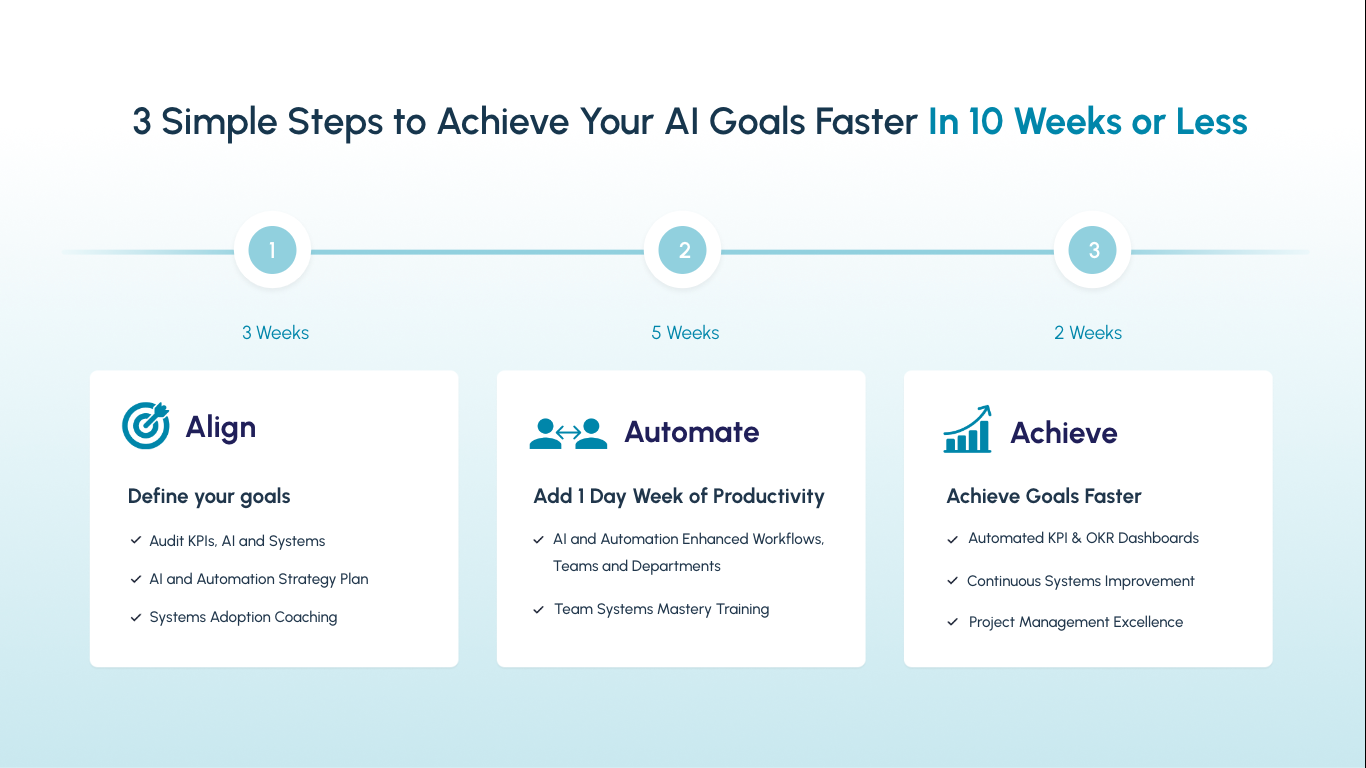
Where teams understand their work, quantify manual effort, and identify automation leverage points
The first phase ensures that every team member knows what to automate, why it matters, and how it connects to the organization’s broader goals.
Each department establishes clear KPIs such as:
We break down weekly responsibilities and quantify manual hours across:
Leaders, managers, and individual contributors help map:
We identify tasks that:
These become the first items logged into each team member’s Automation Backlog.
Hours Identified for Automation: 40 hours per rep per month (validated through the manual-time audit).
Hours Identified: 38 hours per week per marketing unit.
Hours Identified: 42 hours weekly.
Hours Identified: 39 hours weekly.
Hours Identified: 47 hours weekly.
Hours Identified: 40 hours weekly.
By the end of Week 3, every person has a fully scoped Automation & Efficiency Plan containing:
Where teams convert their automation plans into executed, measurable time savings
In this phase, every team member begins implementing small, high-impact AI automations. This avoids “big-bang” transformation and creates compounding improvements every week.
Sales teams lose huge chunks of time to tasks that don’t close deals; data entry, manual prioritization, and chasing follow-ups.
At AlignAI.dev, every rep uses agentic AI to automate the work that slows them down.
Sales Function | Manual Time (hrs/week) | AI Time Saved (hrs/week) | AI-Optimized Time (hrs/week) |
Lead Qualification & Prioritization | 10 | 7 | 3 |
Outreach, Follow-ups & Tracking | 15 | 10 | 5 |
Prospect Scheduling | 7 | 5 | 2 |
Data Entry & CRM Updates | 15 | 8 | 7 |
Pipeline Forecasting & KPI Insights | 8 | 6 | 2 |
Total | 61 hrs | 40 hrs saved | 21 hrs optimized |
This is not theoretical, it’s measurable.
Each rep reclaims ~40 hours a month.
A 10-person team gains 400 hours of productivity, equivalent to 2.5 additional FTEs.
Marketing moves fast, but marketers are often buried in workflows that slow creative output.
AlignAI.dev automates the operational layer so marketers can focus on high-impact work.
Marketing Function | Manual Time (hrs/week) | AI Time Saved (hrs/week) | AI-Optimized Time (hrs/week) |
Content Creation | 18 | 12 | 6 |
Marketing Automation | 10 | 6 | 4 |
Campaign Optimization | 12 | 9 | 3 |
Project Management | 12 | 5 | 7 |
Performance Insights | 9 | 6 | 3 |
Total | 61 hrs | 38 hrs saved | 23 hrs optimized |
That’s 38 hours per week reclaimed, or 152 hours monthly, “adding” the output of a full-time team member without growing headcount.
Operations teams handle planning, reporting, systems, and workflows.
Most of this is predictable, and perfectly suited for automation.
Operations Function | Manual Time (hrs/week) | AI Time Saved (hrs/week) | AI-Optimized Time (hrs/week) |
Project & Resource Planning | 10 | 6 | 4 |
Workflow Optimization & Automation | 12 | 8 | 4 |
Task & Project Management | 7 | 4 | 3 |
Data Entry & Report Generation | 20 | 15 | 5 |
Project Reporting & Analytics | 12 | 9 | 3 |
Total | 61 hrs | 42 hrs saved | 19 hrs optimized |
AI eliminates 69% of repetitive work, creating an operations layer that runs itself.
HR teams thrive when freed from scheduling, filtering, and manual admin.
At AlignAI.dev, we design HR workflows so data, decisions, and processes flow automatically across the employee lifecycle.
HR Function | Manual Time (hrs/week) | AI Time Saved (hrs/week) | AI-Optimized Time (hrs/week) |
Candidate Sourcing & Screening | 12 | 9 | 3 |
Interview Scheduling & Coordination | 8 | 6 | 2 |
Onboarding & Training | 10 | 6 | 4 |
HR Analytics & Workforce Planning | 9 | 6 | 3 |
Employee Satisfaction Tracking | 7 | 5 | 2 |
Payroll & Benefits Management | 10 | 7 | 3 |
Total | 56 hrs | 39 hrs saved | 17 hrs optimized |
The Future of HR Is Human, Because the Admin Isn’t
AI handles the repetitive flow of tasks, giving HR space to do what actually builds culture:
This is HR with less friction, more precision, and more time for real people work.
Finance teams spend hours reconciling, reporting, and validating data.
With automation embedded into their KPIs, those hours come back instantly.
Finance Function | Manual Time (hrs/week) | AI Time Saved (hrs/week) | AI-Optimized Time (hrs/week) |
Reconciliation | 15 | 12 | 3 |
Invoice & Expense Processing | 12 | 9 | 3 |
Forecasting & Reporting | 14 | 10 | 4 |
Compliance & Audit Prep | 10 | 8 | 2 |
Workflow & Task Automation | 9 | 8 | 1 |
Total | 60 hrs | 47 hrs saved | 13 hrs optimized |
That’s 47 hours reclaimed every week, equivalent to one additional full-time finance team member, without hiring.
Every customer-facing team spends massive time on follow-ups, documentation, ticketing, and reporting.
AlignAI.dev automates the entire backend so client-facing time expands.
Client Success Function | Manual Time (hrs/week) | AI Time Saved (hrs/week) | AI-Optimized Time (hrs/week) |
Customer Support | 12 | 8 | 4 |
Surveys & Sentiment Analysis | 9 | 5 | 4 |
Outreach & Engagement | 7 | 5 | 2 |
Renewal & Upsell Tracking | 10 | 7 | 3 |
Ticket Resolution | 10 | 5 | 5 |
Onboarding & Training | 11 | 8 | 3 |
SLA Reporting & Customer Performance | 8 | 4 | 4 |
Total | 61 hrs | 40 hrs saved | 25 hrs optimized |
40 hours saved weekly, equivalent to one additional full-time CSM.
By Week 8, teams experience the shift: They spend less time on admin and more time on selling, building, resolving, forecasting, and strategic work.
Where automation becomes a daily habit and the KPI becomes self-sustaining
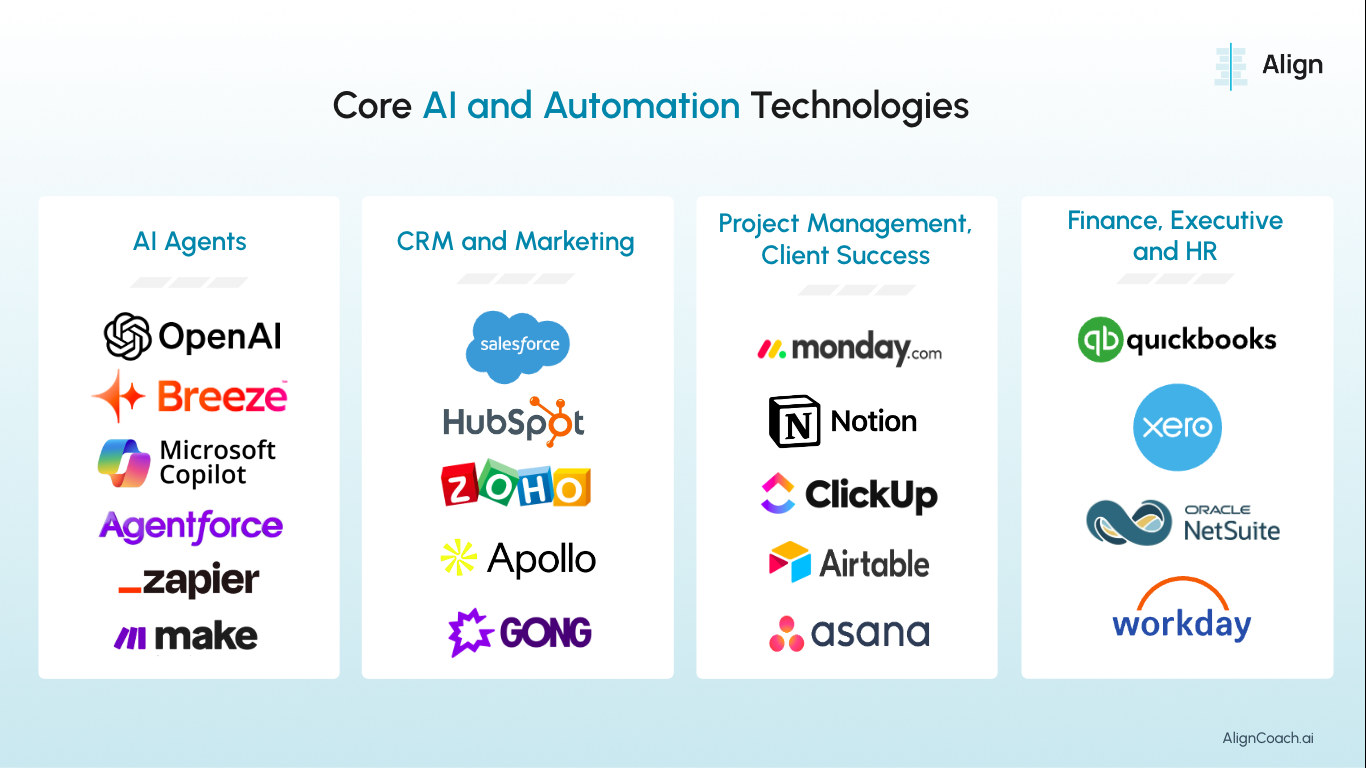
In this stage, teams begin operating with automation as a natural part of their workflow.
Automated visibility into:
AI notifies teams about:
Analytics highlight:
Every quarter, teams refine:
By Week 10, automation becomes a continuous practice, a habit reinforced weekly through the Automate Your Job KPI.
Every team member has a KPI that includes three parts:
A weekly habit:
“What did I do this week that I should never manually do again?”
This identifies patterns before they become bottlenecks.
A short Loom video or process doc captures the workflow so it can be automated.
Based on complexity:
This ensures ownership without requiring engineering-heavy skill sets.
At AlignAI.dev, automation isn’t a one-off project or a side initiative, it’s a core responsibility baked into every role. By making “Automate Your Job” a KPI, we’ve transformed the way teams work: reclaiming dozens of hours per week, eliminating repetitive tasks, and creating more capacity for strategic, high-value activities.
The results are measurable, tangible, and compounding: faster sales cycles, improved customer experiences, more accurate financial reporting, and greater employee satisfaction. Teams operate with clarity, workflows are predictable, and knowledge is captured systematically, reducing dependency on individuals and avoiding operational bottlenecks.
Our Align → Automate → Achieve framework ensures that automation is not just implemented but continuously optimized. Every department, from Sales to Client Success, Finance to HR, benefits from structured, role-level automations that drive efficiency, scale, and impact.
By embedding automation as a responsibility rather than an afterthought, companies gain a durable competitive advantage, reduce burnout, and unlock the full potential of their people.
At AlignAI.dev, this is how we design work: predictable, measurable, and self-improving.
If you want similar developments for your teams, we are offering:
📘 Free Guide: Leading AI-Enhanced Teams
📅 Complimentary 30-min AI Strategy Session: Explore how agentic AI can reclaim hours per week for your teams.
When systems align with strategy, every decision becomes an informed step toward long-term success.