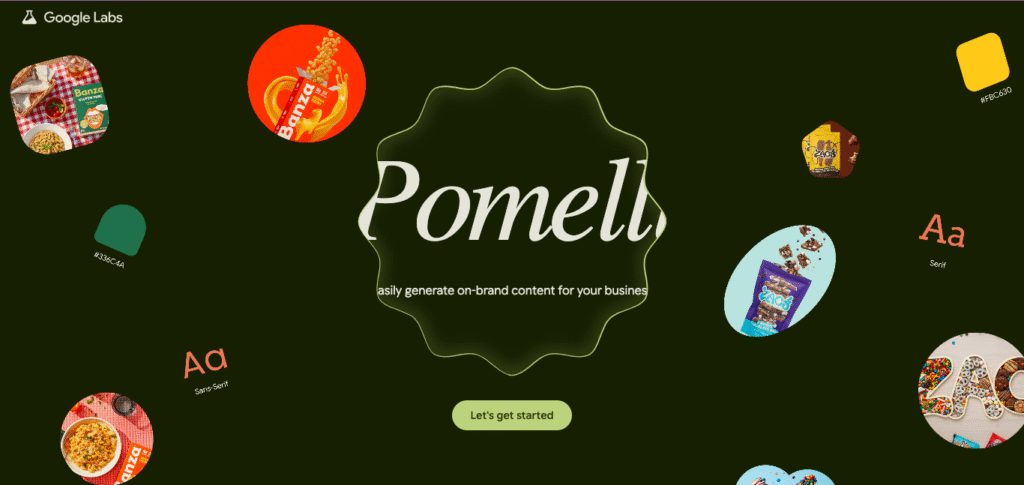
The second I handed our marketing lead the URL of a new tool and watched her grin, I figured we were entering a new era of brand-operations!
A week earlier, I’d been juggling five tools, trapped in the same old loop: Canva for visuals, Docs for copy, managing the calendar, and three uploads per platform.
There has to be a better way, and I’ve discovered it already!
The Pomelli AI.
Launched just last week, Google Labs and DeepMind’s experiment promises this: feed it your website, and get campaign-ready social assets that already sound and look like your brand.
No dozens of tools.
No lengthy briefs.
No brand-consistency wrestling.
I had my marketing manager feed Pomelli our homepage, describing a product launch, and then watch it spin out 12 post ideas, visuals and captions; all aligned with our brand voice. One of the tagline suggestions hit our target so perfectly I stopped the review and just hit “download”. The speed of first drafts alone felt 30-40% faster than any previous workflow.
For many teams in 2025, that speed doesn’t just improve output, it saves morale. Because tool-fatigue is the main factor that kills creativity, and inconsistency is the main factor that kills brand strength.
Here’s what you as an executive need to know: this article will unpack how Pomelli AI works, why it matters now, and how you can apply it using our Align → Automate → Achieve framework so it becomes a reliable system, not another pilot.
Because I believe, the companies that will lead tomorrow won’t just have creative teams, they’ll have intelligent systems that are creative.
What Is Pomelli AI?
Pomelli entered public beta on October 28, 2025.
It is currently available (English language) in the U.S., Canada, Australia and New Zealand.
No credit‑card, no waitlist: just visit labs.google.com/pomelli and start.
In simple terms: Pomelli AI is a brand-aware marketing agent. You give it your website; it analyzes your brand voice, visuals, and messaging. It then generates campaign ideas, social posts, design assets, and variations; all grounded in your identity.
It’s not simply a generative content tool, it’s a workflow engine targeted at marketing teams and SMBs that don’t have deep design or copy-resources.
Built on DeepMind technology
Under the hood, Pomelli leverages DeepMind research and Google’s generative models to interpret brand identity. It scans your public site (text + images) and extracts tone, visual style, messaging.
Note: You don’t need to upload your brand book or PDFs, the system learns from your live website. (Trade‑off: if your website is weak, the output will reflect that.)
Key Capabilities
- Business DNA builder: Submit your site, and Pomelli extracts tone, visual styling, colors, fonts, imagery.
- Campaign idea generation: Suggests tailored themes (e.g., “fall launch”, “community outreach”) or accepts your prompt.
- Asset creation: Produces platform-ready posts for Instagram, Facebook, X/Twitter, LinkedIn, image + copy combinations aligned to your brand.
- Edit & download: You refine if needed, then export assets and upload them manually to your platforms (scheduling still external).
Why Pomelli AI Matters Now
Key Market Stats & Forecasts
- A study referenced in the Pomelli guide says consistent brand presentation (which Pomelli helps enforce via its “Business DNA” approach) can increase revenue by up to 23% for businesses.
- The announcement material for Pomelli states it allows SMBs to “easily generate scalable, on‑brand social media campaigns” by analysing their website and then producing marketing assets.
- One independent analysis of Pomelli notes “creating 10 post variations took ~60 seconds … compared to our usual Canva workflow, that felt 30‑40% faster to get publishable first drafts.”
- ~60% of SMBs that are using AI or automation in their marketing say they have saved time and are working more efficiently.
- The announcement emphasizes Pomelli is free during its public beta in several English‑language countries (US/Canada/Australia/New Zealand), lowering the cost barrier for SMB adoption.
- Given the positioning of Pomelli as a “marketing department in a browser” for small businesses, it speaks to the trend that AI tools are increasingly enabling small teams to compete on the same design/voice level as larger brands, which implies improved scalability and lower marginal cost per asset.
What These Numbers Mean for Executives & Marketing Leaders
- Efficiency gains are real: The stat about 30‑40% faster first drafts means teams using Pomelli could dramatically reduce “blank canvas” time, speeding up campaign rollout.
- Potential revenue uplift via brand consistency: With consistent brand presentation able to boost revenue by up to ~23%, tooling like Pomelli that auto‑enforces brand DNA may help realise those gains.
- Lower cost of entry for SMBs: Free beta access and automation of design + copy production mean smaller teams can access higher‑quality outputs without proportional increase in staff or budget.
- Scalability advantage: With the large marketing‑AI market growth projections, companies that embed tools like Pomelli early may capture first‑mover advantage in content generation workflows.
- Shift from manual to strategic roles: If asset creation becomes faster and more automated, teams can shift focus from “make the visuals” to “craft the strategy, test the messaging, optimize performance”.
- Risk of lagging behind: As more companies adopt AI‑driven content generation, those that stick with manual, slow processes could fall behind in speed, brand consistency and cost‑efficiency.
How Pomelli AI Works (Technically)
Here’s a deeper dive into how this engine runs under the hood.
Step 1: Brand Profiling “Business DNA”

Before anything else, Pomelli asks you for your website URL. It then:
- Crawls public pages, reads copy and existing images.
- Analyses tone of voice (formal vs informal, friendly vs serious) based on text.
- Extracts visual cues: fonts, colour palettes, photo styles.
- Builds a brand‑profile (“Business DNA”) that becomes the reference for all outputs.
This removes the need for manual brand kit uploads. However, if your website is outdated, minimal, or unrepresentative, the agent’s “learning” will reflect that risk.
Step 2: Idea Generation
Once the DNA profile is built, you choose or type your campaign goal (e.g., “Promote new product”, “Announce event”, “Holiday sale”). The system then:
- Suggests multiple campaign concepts tailored to your brand + target (based on website context + prompt).
- Allows you to input custom prompts if you already have a direction.
Step 3: Content Creation
With a campaign idea selected, the agent generates:
- Copy: Captions, post text, hashtag suggestions, platform‑specific variants.
- Imagery: Images aligned to your brand visuals (colour, style) and campaign angle.
- Layouts: Formatting appropriate to the selected platform (size, ratio, text overlay) and downloadable assets.
You can then review, edit inside the tool (text tweak + image tweak) & download the ZIP of assets for manual upload.
The AAA Framework: Align → Automate → Achieve for Pomelli AI Adoption
Deploying Pomelli AI isn’t just about using an AI tool to generate social posts. It’s about embedding autonomous brand-consistent content creation into your marketing workflows. Without a structured approach, even the most promising AI experiments can remain pilots with limited ROI.
The Align → Automate → Achieve (AAA) Framework ensures Pomelli isn’t just a tool you try, it’s a system your team leverages to scale marketing impact efficiently.
Step 1: Align (3 Weeks)
Before generating content, you need to define why, where, and how Pomelli fits into your workflow. Pomelli can only accelerate what has already been clearly defined.
Key Activities:
- Define top business outcomes
- Examples:
- “Generate 20+ brand-consistent social posts per month.”
- “Reduce first-draft creation time by 50%.”
- “Maintain visual & tonal brand consistency across 4 social platforms.”
- Audit current marketing stack
- Map all tools: Canva, Docs, Sheets, scheduling apps.
- Identify bottlenecks, redundant steps, and handoff friction points.
- Interview stakeholders
- Marketing manager, designer, social media lead, agency partners.
- Surface pain points (e.g., inconsistent captions, slow visual creation, platform-specific formatting).
- Design pilot workflows
- Start small: e.g., “Weekly Instagram + LinkedIn posts for product launch.”
- Keep scope manageable while targeting high ROI.
- Establish governance
- Define review roles, who approves AI-generated content.
- Set brand guardrails (tone, prohibited visuals, key messaging).
- Audit logs, i.e. track prompts, outputs, edits.
Departments of Focus & Use Cases
Every part of your organization can benefit when content generation is systematic, not ad-hoc.
Marketing
- Pain point: 4 tools, 2 freelancers, 3 revisions = one campaign.
- With Pomelli: Insert website → select campaign → get 10-15 assets in minutes.
- Use case: E-commerce brand launching a summer collection; Pomelli generates IG feed + Stories + LinkedIn Promo in one go. Time to first-draft: ~60 seconds.
Sales / SDR
- Pain point: SDRs spend hours writing outreach posts or case-study updates.
- With Pomelli: Generate social posts tailored for LinkedIn “why we built” narrative + images + captions.
- Use case: SaaS founder posts weekly “behind the build” series that aligns with brand story and converts leads.
Operations / Internal Comms
- Pain point: Inconsistent visual identity leaks into internal announcements, onboarding documents.
- With Pomelli: Use brand DNA to generate internal posts (e.g. “Welcome 10 new hires”) that align visually and tonally.
- Use case: HR team releases new hiring batch graphic + caption in minutes.
Client Success / Community
- Pain point: Clients expect social posts (think case studies) but your team lacks design capacity.
- With Pomelli: Generate approx. 12 posts for “Client stories” batch ahead of time.
- Use case: Agency serving multiple SMB clients creates separate brand profiles and batches assets monthly, cutting prep time ~40%.
Executive / Leadership
- Pain point: Lack of visibility on how content asset production ties to brand or ROI.
- With Pomelli + Align: Executives get dashboards showing assets generated, usage rates, brand-consistency metrics, time saved, cost avoided.
- Use case: CMO uses weekly summary to track “assets produced per hour” and “manual vs automated asset ratio”.
Leadership Alignment Roles:
- CMO / Marketing Lead: Defines campaign goals, brand messaging guardrails
- Creative Lead / Designer: Ensures visual consistency, approves images
- Social Media Manager: Maps content to platforms, approves copy & hashtags
- Operations / PM: Manages workflow integration, downloads, and asset distribution
By the end of this phase, every stakeholder understands where Pomelli fits, why it matters, and how they’ll interact with it.
Step 2: Automate (3–5 Weeks)
With workflows aligned, it’s time to turn Pomelli AI into a semi-autonomous content engine.
Core Execution Layers:
- Workflow Intelligence Mapping
- Convert existing content creation steps into Pomelli prompts and pipelines.
- Define campaign goals, platform variants, tone/visual constraints.
- Deployment
- Input website(s) to build Business DNA.
- Run initial content batches for different channels (Instagram, X/Twitter, LinkedIn, Facebook).
- Review, edit, and download assets for distribution.
- Iteration & Monitoring
- Track which outputs hit brand alignment; flag inconsistencies.
- Adjust prompts or refine Business DNA if needed.
- Team Training & Calibration
- Teach staff how to prompt, review, and select best outputs.
- Encourage feedback loops to improve output quality and relevance.
Pomelli AI Core Features & Executive Benefits
Component | What it does | Why it matters |
Business DNA builder | Scans your website (text + visuals) and constructs a brand identity profile (tone of voice, fonts, palette, imagery) | Removes manual brand‑kit setup; ensures brand‑consistent content |
Campaign‑idea generator | Provides tailored campaign concepts or allows custom prompts | Speeds up ideation, removes creative block |
Content generator (copy + images) | Generates social‑media assets (captions, platform variations, visuals) | Cuts from blank‑page to publishable asset fast |
Multi‑platform formatting | Outputs content tailored for Instagram, Facebook, X/Twitter, LinkedIn | Reduces reformatting overhead per channel |
Editable assets & download‑ready | Lets you tweak output then download images + copy for manual upload | Maintains human‑in‑loop control and final quality |
By the end of this phase, Pomelli can autonomously produce campaign-ready content while your team shifts from tactical execution to strategic oversight.
Step 3: Achieve (2 Weeks)
Now you scale, refine, and institutionalize Pomelli in your content workflows.
Steps:
- Deploy performance dashboards
- Track outputs: number of posts, variations, time saved, content engagement.
- Measure alignment to brand DNA and campaign goals.
- Monitor adoption & usage
- Which teams use Pomelli? Which assets get posted?
- Identify gaps, friction points, or override instances.
- Continuous improvement loops
- Refine prompts, Business DNA, and workflow mapping based on performance.
- Expand campaign types (product launches, seasonal campaigns, events).
- Scale across teams
- Apply Pomelli to agency client accounts or multiple brand sites.
- Train additional staff, reward adoption, and recognize best practices.
- Embed a “human-plus-agent” mindset
- Treat Pomelli as a collaborator, not a replacement.
- Focus human effort on strategy, creative oversight, and engagement measurement.
In 10 weeks, Pomelli becomes part of your marketing infrastructure: content pipelines run faster, brand consistency is ensured, and your teams are empowered to focus on strategy and growth.
Best Practices for Adoption
- Start with one campaign use-case (e.g., Instagram feed for upcoming launch) rather than the whole stack.
- Prepare your website: Refresh key pages, ensure tone and visuals are aligned.
- Train users: How to refine prompts, review assets, approve and schedule.
- Build performance metrics: Track time saved, cost avoided, asset-to-published ratio.
- Expand gradually: Once proficiency and process are established, scale across departments.
Ultimately…
Pomelli AI represents a meaningful leap: from generic templates to brand-aware campaign engines. For businesses that adopt it thoughtfully, this means faster execution, tighter brand control, and more strategic bandwidth freed.
But the tool alone isn’t enough. Execution depends on structure.
That’s where AlignCoach.ai’s Align → Automate → Achieve framework comes in: helping you deploy Pomelli AI not as another experiment, but as a strategic system embedded into how you operate.
👉 Ready to turn your website into a marketing engine?
🚀 Free Guide: Download our “Autonomous-Agent Executive Playbook”, a practical guide for leaders ready to embed AI into core operations.
📅 Complimentary AI Strategy Session: Book your 30-minute Align AI Strategy Session. Let’s map out how Pomelli AI can plug into your ecosystem; securely, measurably, and with real business impact.